
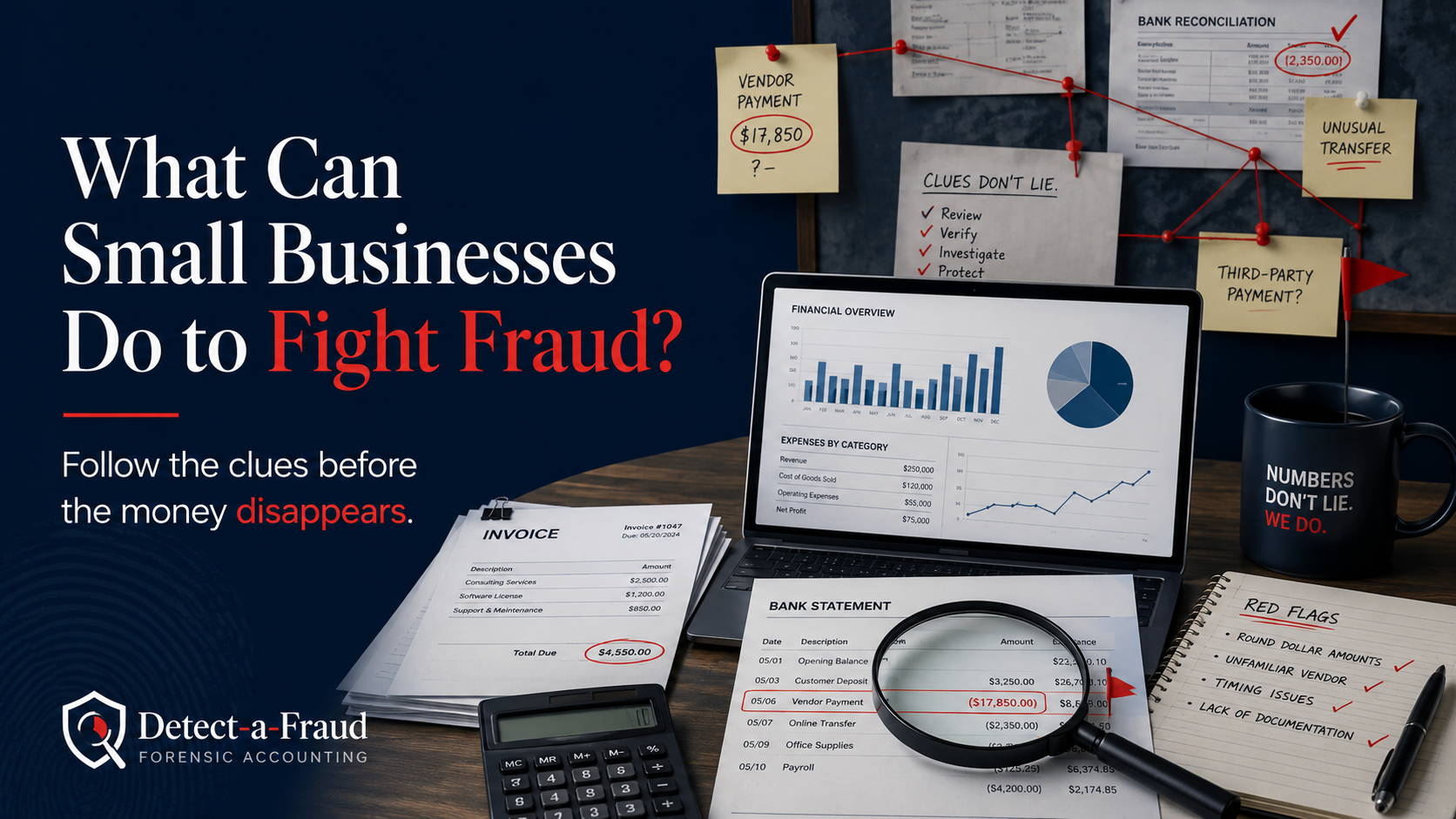
Follow the Clues Before the Money Disappears
Fraud rarely kicks down the front door.
It slips in quietly.
A vendor sends “updated” banking instructions.
An employee reimbursement looks just normal enough.
A payroll change goes through without a second set of eyes.
A fake invoice lands in the inbox on a busy Thursday afternoon.
And just like that, the money is gone.
For small businesses, fraud is not some dramatic movie plot with a criminal mastermind in a dark room. Most of the time, it is boring. It is ordinary. It looks like paperwork, emails, logins, invoices, refunds, and bank transfers.
That is what makes it dangerous.
At Detect-a-Fraud, we believe business owners do not need to become forensic accountants to protect their money. But they do need to know where to look, what clues matter, and when something does not pass the smell test.
Because fraud leaves clues.
The question is, are you looking?
The Fraud Scene Has Changed
Old-school fraud used to be easier to spot.
Bad grammar. Weird emails. Suspicious checks. A fake invoice that looked like it was made in 1998.
Not anymore.
Today’s fraudsters are polished. They use artificial intelligence, stolen data, fake identities, social engineering, and convincing digital messages to make scams look legitimate. According to TransUnion’s 2026 fraud trends update, digital fraud continues to grow more sophisticated, with criminals using tools like generative AI to scale scams and make them harder to detect.
In plain English?
The bad guys got better tools.
So small businesses need better habits.
And no, “I trust my people” is not a fraud prevention plan. Trust is wonderful. Controls are better.
Clue #1: One Person Controls Too Much
Here is one of the biggest red flags in any small business:
One person can set up vendors, approve bills, make payments, record transactions, and reconcile the bank account.
That is not efficiency. That is exposure.
When one person controls the whole money trail, fraud becomes easier to hide. Even honest mistakes become harder to catch.
You do not need a huge accounting department to fix this. You just need checks and balances.
For example:
The person entering bills should not be the only person approving payments.
The person reconciling the bank account should not be the only person moving money.
New vendors should require review.
Payroll changes should require approval before payday.
The owner should review financial reports every month.
Think of it like a detective case. You would not let one witness write the report, collect the evidence, approve the conclusion, and lock the file away.
So why let one person control the entire money process?
Clue #2: Payment Changes Happen Too Easily
Fraudsters love payment changes.
Why? Because they work.
A scammer sends an email pretending to be a vendor:
“Please update our banking information for future payments.”
The email looks real. The signature looks real. The timing feels normal.
But the bank account belongs to a criminal.
Your best defense is simple:
Verify payment changes through a separate, trusted channel before money moves.
Do not reply to the same email.
Do not call the number listed in the suspicious message.
Do not trust the attached form just because it has a logo.
Use a phone number or contact already on file.
This one habit can save a business thousands of dollars.
The Detect-a-Fraud rule?
New payment instructions are guilty until proven legitimate.
Clue #3: The Books Are Messy
Fraud loves messy books.
Unreconciled bank accounts.
Old outstanding checks.
Duplicate vendors.
Random journal entries.
“Miscellaneous” expenses.
Credit card charges nobody reviews.
Payroll reports nobody understands.
That is where fraud hides.
Clean books are not just about tax time. They are part of your security system.
Every month, someone should review:
Bank reconciliations
Credit card reconciliations
Payroll reports
Vendor payments
New vendors
Refunds and credits
Large or unusual transactions
Expense reimbursements
Old outstanding checks and deposits
You are not just asking, “Does this balance?”
You are asking better questions:
Why did this vendor get paid twice?
Why did payroll increase when headcount stayed the same?
Why are there so many reimbursements to one employee?
Why is this transaction coded to “miscellaneous”?
Why was this payment made on a weekend?
Why does this vendor address look familiar?
That is the mindset shift.
Bookkeeping tells you what happened.
Fraud detection asks, “Does this make sense?”
Clue #4: Access Is Too Loose
Who has access to your bank account?
Who can run payroll?
Who can change vendor information?
Who can issue refunds?
Who can view sensitive client or customer information?
Who still has access even though they left the company six months ago?
If you do not know the answer, that is a problem.
Small businesses should review access regularly. Not once when the software is set up. Not when something goes wrong. Regularly.
Start with the big ones:
Bank accounts
Credit cards
Payroll systems
Accounting software
Merchant accounts
Email accounts
Cloud storage
Payment processors
Remove old users. Limit admin permissions. Turn on multi-factor authentication. Stop sharing logins.
Shared logins are not teamwork. They are a crime scene waiting to happen.
Clue #5: Nobody Wants to Slow Down
Fraudsters do not just steal money. They create pressure.
They use urgency because urgency makes smart people skip steps.
“Can you send this wire today?”
“I need this gift card for a client.”
“Please update this account before the next payment.”
“Do not tell anyone, I am in a meeting.”
“Click here to avoid account suspension.”
Sound familiar?
The antidote is simple, but powerful:
Pause.
Fraud prevention often comes down to one sentence:
“Let me verify that and get back to you.”
That sentence gives your team permission to slow down. It interrupts the scam. It puts the business back in control.
Busy does not have to mean vulnerable.
Clue #6: There Is No Written Approval Policy
If your fraud prevention plan lives in someone’s head, it is not a plan.
Small businesses need a written approval policy.
It does not have to be fancy. One page is enough.
It should answer:
Who can approve bills?
Who can approve refunds?
Who can approve payroll changes?
What dollar amount requires owner approval?
What payments require two approvals?
How are vendor changes verified?
Who reviews bank activity?
What happens when something looks suspicious?
Here is the truth most business owners do not want to hear:
When there is no policy, the policy becomes “whatever feels easiest in the moment.”
And fraud loves easy.
Clue #7: Employees Do Not Know What to Report
Your team may be your best fraud detection tool.
But only if they know what to look for.
Train employees to watch for:
Unexpected payment requests
New banking instructions
Unusual refund requests
Suspicious attachments
Password reset emails
Requests for secrecy
Gift card or crypto requests
Slightly misspelled email domains
Vendors pressuring for urgent payment
Customers asking for strange refund methods
And make it safe to raise a hand.
Nobody wants to be the person who “causes trouble.” So you have to make the expectation clear:
If something feels off, say something.
A false alarm is cheaper than a fraud loss.
Every single time.
Clue #8: The Owner Is Too Far Removed
This one may sting a little.
Some fraud happens because the owner has completely stepped away from the money.
Delegation is good. Blind delegation is not.
You do not need to do the bookkeeping yourself. In fact, you probably should not. But you do need to understand what is happening in your business.
At minimum, owners should review:
Bank balances
Profit and loss reports
Balance sheet
Accounts receivable
Accounts payable
Payroll summaries
Credit card activity
Large or unusual payments
You are not trying to become the accountant.
You are staying close enough to the evidence that nobody can quietly rewrite the story.
The Detect-a-Fraud Small Business Checklist
Want to start fighting fraud today?
Start here:
Review who has access to your bank, payroll, and accounting systems.
Turn on multi-factor authentication.
Stop sharing logins.
Require independent verification for vendor banking changes.
Review bank and credit card reconciliations monthly.
Separate bill entry, approval, payment, and reconciliation where possible.
Create a simple written approval policy.
Review new vendors every month.
Train employees to pause before acting on urgent financial requests.
Make it easy and safe to report suspicious activity.
You do not have to fix everything overnight.
But you do need to start.
Because fraud prevention is not about paranoia. It is about paying attention.
Final Verdict
Fraud leaves clues.
Sometimes they are buried in the bank statement.
Sometimes they are hiding in payroll.
Sometimes they show up as a rushed email.
Sometimes they are sitting in plain sight inside messy books.
The businesses that catch fraud early are not lucky.
They are looking.
Small business owners do not need bigger fear. They need better systems. They need clean books, clear approval processes, tighter access, and a team that knows when to slow down.
So here is your next move:
Pull your user access reports today. Bank, payroll, accounting software, credit cards, and payment processors. Remove anyone who should not be there. Turn on multi-factor authentication. Then choose one money process, vendor payments, payroll, refunds, or reimbursements, and add one extra review step.
That is how you start building a business fraudsters do not want to mess with.
