
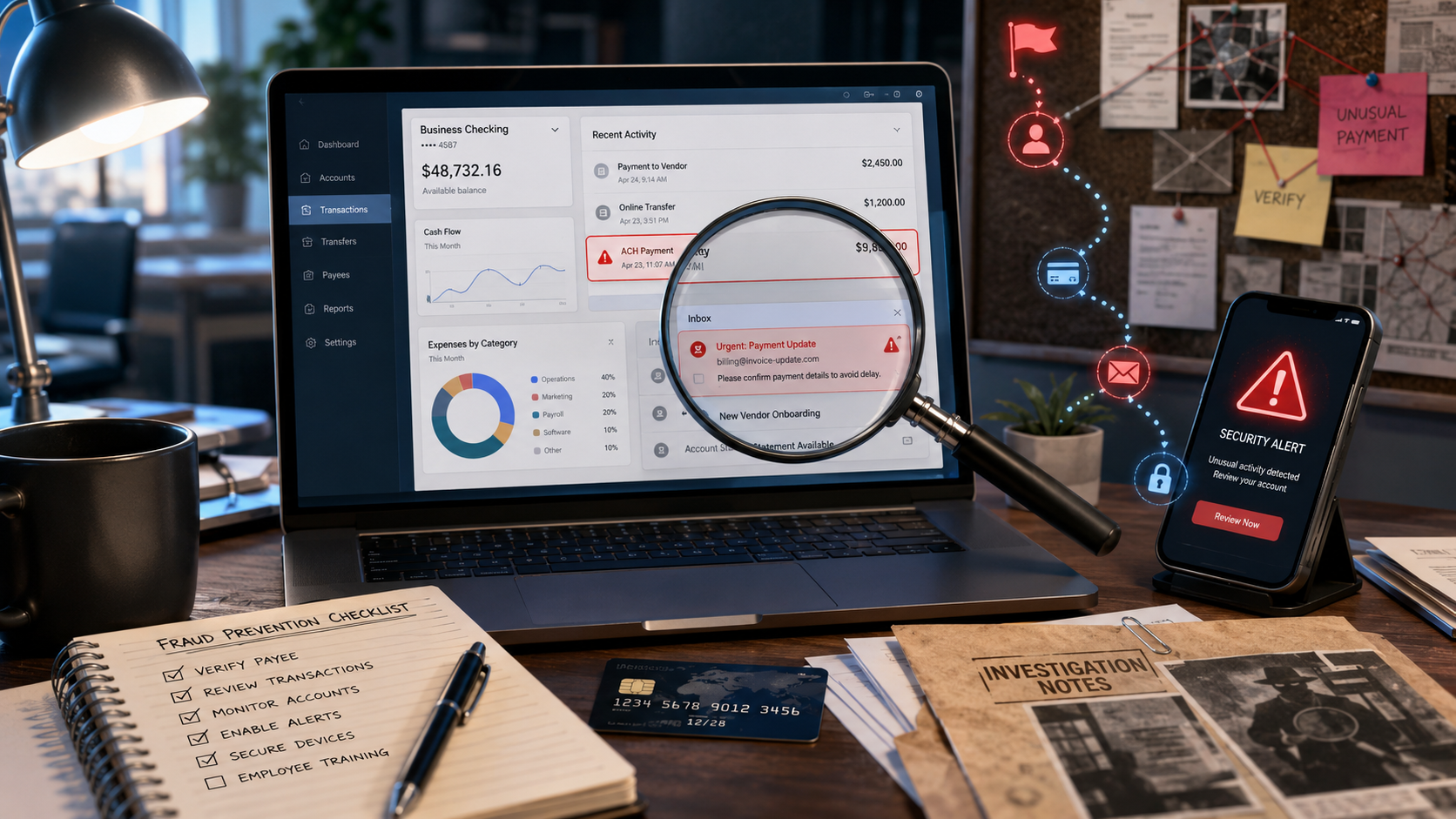
There is something a little terrifying about how easy it is to move money now.
That is great when you are paying a vendor at 9:30 p.m. because you forgot earlier. Not so great when someone on your team gets a fake “urgent” email and sends money to the wrong place before anyone has time to ask, “Wait, does this even make sense?”
That is where small businesses are right now.
We have faster banking, faster apps, faster payments, faster everything. But a lot of businesses have not slowed down long enough to build controls around all that speed.
And fraudsters know it.
They are counting on the fact that your office manager is busy, your bookkeeper is juggling ten things, your owner is traveling, and everyone is trying to be helpful.
Helpful is wonderful.
Helpful without verification is expensive.
The New Crime Scene Is Your Inbox
A fake invoice does not have to look ridiculous anymore.
It might have your vendor’s logo. It might have the right tone. It might reference a real project. It might even come from an email address that is one letter off from the real one.
And when someone is trying to get through the day, one letter is easy to miss.
That is what makes digital finance so tricky. The money does not usually disappear because someone in the business is foolish. It disappears because the fraudster caught someone in a normal human moment.
Busy.
Distracted.
Rushed.
Trying to be useful.
That is all it takes.
One payment link.
One QR code.
One “new banking instructions” email.
One call from someone pretending to be the bank.
One “we accidentally paid you, can you send it back?” message.
None of those things sound wild anymore. They sound like a Tuesday.
The Problem Is Not Just Big, Dramatic Fraud
When people hear “fraud,” they picture a huge wire transfer or someone emptying the bank account.
That happens.
But sometimes the more realistic problem is quieter.
A subscription nobody uses.
A weird $24.99 charge that keeps hitting the card.
A software renewal that no one approved.
A payment app transfer that no one can explain.
A vendor name that looks almost right, but not quite.
That stuff is easy to ignore because it feels small. And honestly, when you are running a business, who wants to stop everything over $24.99?
But that is exactly why small charges are worth paying attention to.
They teach you whether anyone is actually watching.
If nobody questions the little things, the big things have a much better chance of getting through.
Fraudsters Love a Messy Process
Most small businesses are not reckless. They are just moving fast.
There is a difference.
The problem is, fraudsters do not care why the gap exists. They only care that it exists.
If your vendor payment process is basically “forward the email to whoever pays bills,” that is a gap.
If bank changes are handled by replying to an email, that is a gap.
If one person can set up a vendor, approve the bill, and release the payment, that is a gap.
If nobody reviews credit card charges until tax time, that is a gap.
If former employees still have access to email, software, payroll, or payment apps, that is a very large flashing neon gap.
And here is the part people do not love hearing: trust does not fix any of this.
You can trust your team and still need controls.
Actually, good controls are one of the best ways to protect your team. They keep honest people from being put in bad positions. They prevent finger-pointing. They make the process clear.
Nobody has to guess.
Slow the Money Down
This is the simplest fraud prevention advice I can give a small business:
Slow the money down before it leaves.
Not forever. Not with five committees and a binder nobody reads.
Just long enough to verify.
If someone wants to change banking information, call the vendor using the phone number you already had on file.
If someone sends a payment link, go directly to the website instead of clicking.
If someone calls from the “fraud department,” hang up and call the bank yourself.
If an employee asks to change direct deposit, verify it through a separate channel.
If money was sent to you by “mistake,” do not just send it back because the person is panicking. Talk to your bank first.
Fraudsters want you moving quickly because speed keeps you from thinking.
So think.
Pause.
Check.
Then move the money.
A Few Rules That Actually Work
You do not need a complicated fraud policy to get better at this. You need a few rules your team actually follows.
First, no payment information changes by email alone. Ever.
That includes vendors, contractors, employees, and clients. If banking details change, someone verifies by phone using information already on file. Not the number in the email. Not the number on the new invoice. The number you already had.
Second, use two sets of eyes for payments.
One person should not be able to create, approve, and send money with no review. I know this can feel annoying in a small business. Do it anyway. Annoying is better than missing $18,000.
Third, review bank and credit card activity every week.
Not just the balance. The transactions.
Look at vendor names. Look at subscriptions. Look at payment apps. Look at anything round-numbered, duplicated, unfamiliar, or just plain weird.
Your books are not just for taxes. They are evidence. Use them.
Fourth, clean up access.
When someone leaves, remove their access the same day. Email. Bank portals. payroll. Accounting software. Credit cards. Shared drives. Payment apps. All of it.
Not because you think they are going to steal. Because loose access is bad business.
Fifth, train your team to question urgency.
This may be the biggest one.
Any message that says “right now,” “confidential,” “do not call,” “final warning,” “account locked,” or “the owner approved this” deserves a second look.
A real emergency can survive a verification call.
A scam usually cannot.
The Part Business Owners Miss
A lot of owners think fraud prevention means they personally need to watch everything.
That is not realistic.
You are already doing enough. You cannot be the CEO, sales team, operations manager, bookkeeper, fraud analyst, IT department, and human firewall all at once.
The goal is not to make you more paranoid.
The goal is to make the business less dependent on you noticing every single thing.
That means written procedures. Clear approval limits. Limited access. Regular reviews. A team that knows it is allowed to slow down when money is involved.
That is how you build a business that can protect itself.
Follow the Money Before Someone Else Does
Digital finance is not going away, and it should not. Online banking, payment apps, automated billing, and cloud tools make life easier.
But easier does not always mean safer.
So take a look at your business this week. Pick one area where money moves.
Vendor payments.
Payroll changes.
Credit card charges.
Subscriptions.
Client refunds.
Bank transfers.
Now ask the uncomfortable question:
Where could someone trick us?
That answer is your first clue.
Start there. Tighten that process. Then move to the next one.
You do not have to fix everything today.
But you do need to stop assuming that “we would catch it” is a fraud prevention plan.
It is not.
A plan has rules.
A plan has review.
A plan has verification.
And in the Wild West of digital finance, verification is what keeps your money from riding off into the sunset.
