
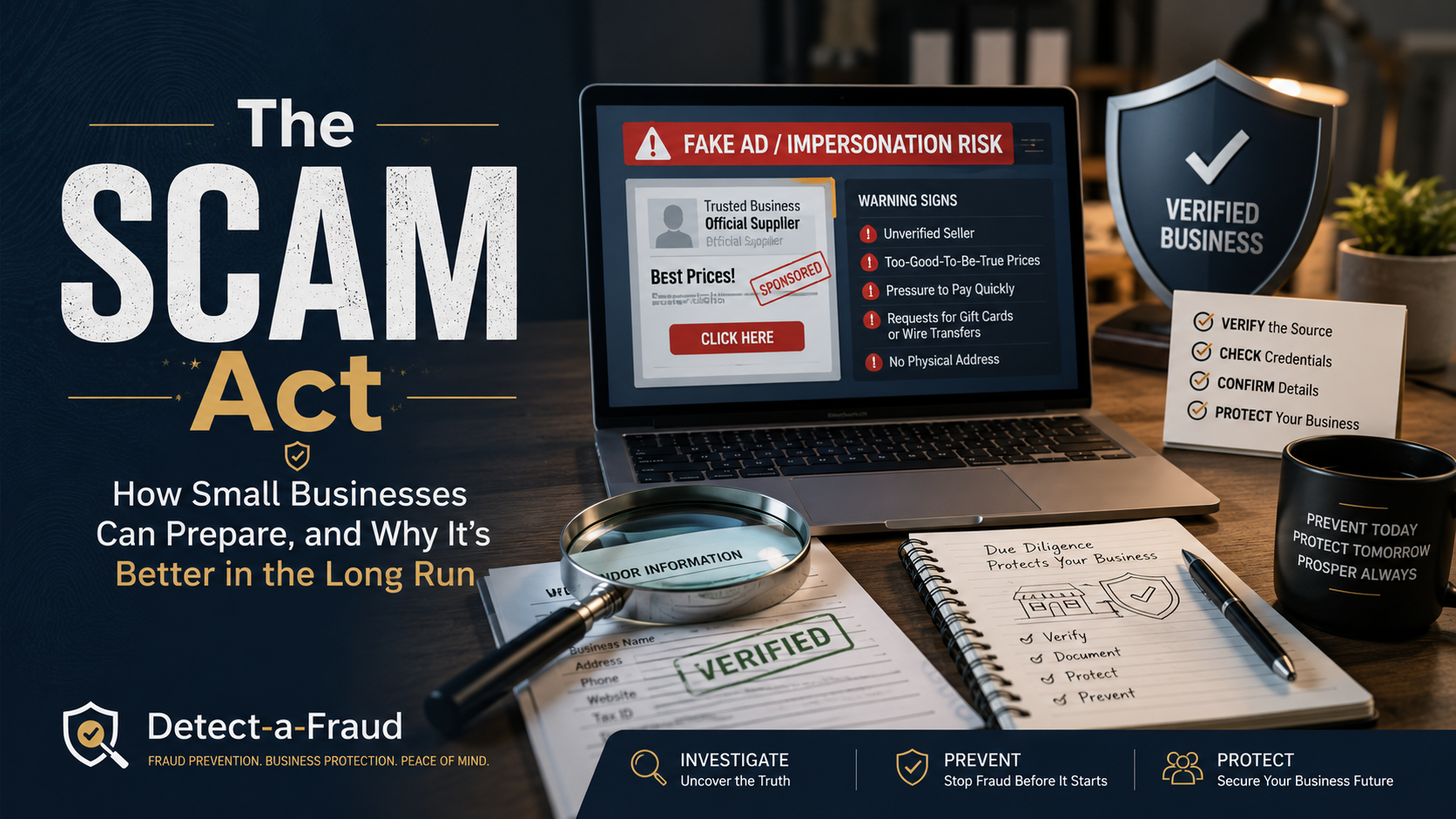
Fraud rarely walks in wearing a mask.
Most of the time, it shows up looking professional.
A polished ad.
A familiar logo.
A fake bank login.
A vendor payment change.
A “customer support” link that feels completely normal.
That is what makes today’s scams so dangerous. They do not look like scams anymore.
The proposed SCAM Act, short for the Safeguarding Consumers from Advertising Misconduct Act, is aimed at one of the places fraud often begins: online ads and impersonation.
In plain English, the bill would push online platforms to do more to verify who is buying ads and detect when someone is pretending to be a legitimate business, bank, vendor, or trusted brand.
For small businesses, that may mean more verification steps when running ads. More paperwork. More proof that your business is really your business.
Annoying? Yes.
Worth it? Also yes.
Because in fraud prevention, a little friction upfront is usually a whole lot cheaper than cleaning up the mess after money is gone.
The Crime Scene: Fake Ads and Impersonation
Let’s set the scene.
A busy office manager needs to log into the company bank account. She searches for the bank online. The first result looks right. The logo is there. The name looks familiar. She clicks.
But it is not the bank.
It is a fake ad leading to a fake website.
She enters the login credentials, and now the fraudster has exactly what they need.
No ski mask.
No break-in.
No dramatic hacking scene.
Just one well-placed ad.
That is the modern fraud playbook.
Fraudsters know small businesses move fast. They know employees are juggling client work, invoices, payroll, vendor bills, email, and customer questions. They know that when people are rushed, they do not investigate. They react.
And reaction is exactly what fraudsters are counting on.
Why Small Businesses Should Pay Attention
The SCAM Act is not just a “big tech” or “banking industry” issue.
It matters to small businesses because small businesses are both targets and potential victims of impersonation.
A scammer could impersonate:
Your bank
Your payroll provider
Your accounting software
Your payment processor
Your law firm, CPA firm, or bookkeeping company
Your vendors
Your business itself
That last one is important.
Imagine a customer calls and says, “I clicked your ad and paid the invoice.”
But you never ran that ad.
You never sent that invoice.
You never received the money.
Now your business has a reputation problem, a customer service problem, and possibly a fraud investigation on your hands.
That is why prevention matters.
The goal is not to make business harder for honest companies. The goal is to make fraud harder for criminals.
Will This Create More Work for Legitimate Businesses?
Probably.
Let’s be real. Any time platforms add verification requirements, honest businesses feel some of the friction too.
You may be asked to verify:
Your legal business name
Your DBA or trade name
Your physical address
Your EIN or tax identification information
Your website domain
Who is authorized to manage your ads
Whether you have permission to use certain brand names, logos, or trademarks
That may slow down ad approvals. It may create more back-and-forth with platforms. It may require better documentation from marketing agencies or contractors.
But here is the question every business owner should ask:
Would you rather prove who you are now, or prove you were not the scammer later?
Because those are very different investigations.
One is paperwork.
The other is damage control.
The Long-Term Win: Less Room for Fraudsters to Hide
Fraudsters love weak systems.
They love vague ownership.
They love old account access.
They love businesses with inconsistent names across platforms.
They love teams that search for login pages instead of using saved links.
They love payment changes that nobody verifies.
The SCAM Act may force platforms to tighten their side of the system. But small businesses should use this moment to tighten theirs too.
This is not about becoming paranoid.
It is about becoming harder to fool.
Think of it like locking your office door. Is it inconvenient to carry a key? Maybe. But nobody argues that unlocked doors are a better business strategy.
The same is true online.
Verification, documentation, access controls, and payment procedures are not red tape. They are locks on the digital doors of your business.
How Small Businesses Can Prepare Now
You do not need to wait for a law to pass before you start protecting your business.
Here are the practical steps small businesses should take now.
1. Clean Up Your Business Identity
Start by making sure your business looks like the same business everywhere.
Check your:
Website
Google Business Profile
Social media profiles
Online directories
Advertising accounts
Payment processors
Bank accounts
Secretary of State records
IRS records
Business licenses
Your legal name, DBA, address, phone number, website, and email domain should connect clearly.
If your legal name is one thing, your ads say another, your website uses a third variation, and your payment account has an old address, you are creating unnecessary confusion.
And confusion is where fraud hides.
This does not mean you cannot use a brand name. It means your records should tell a clean story.
When a platform, bank, vendor, or investigator asks, “Is this really your business?” the answer should be easy to prove.
2. Create a Business Identity Evidence File
Every small business should have a simple digital folder that proves who they are.
Call it your Business Identity File.
Include:
Formation documents
DBA registrations
EIN confirmation letter
Business licenses
Trademark records, if applicable
Domain registration details
Logo files
Brand guidelines
Screenshots of official online profiles
Advertising account ownership information
Marketing agency agreements
Authorized user lists
This is not glamorous work. But when fraud happens, glamorous does not help you. Documentation does.
If someone impersonates your business, you do not want to waste three days digging through old emails trying to prove you are the real company.
Have the evidence ready before you need it.
3. Know Who Has Access to Your Ad Accounts
Ad accounts are often treated casually.
A former employee still has access.
An old agency is still connected.
A contractor has admin rights they no longer need.
A payment method is outdated.
Nobody knows who actually owns the account.
That is not a marketing issue.
That is a fraud risk.
Review every platform where your business runs ads. Remove old users. Turn on multi-factor authentication. Confirm the business owner or leadership team has control of the account. Document who is allowed to create, edit, approve, and pay for ads.
Fraud prevention is not just about stopping outsiders.
Sometimes it starts with cleaning up the keys you already handed out.
4. Bookmark Critical Login Pages
This one is simple, boring, and powerful.
Do not let your team search for critical login pages.
Bookmark the official pages for:
Banking
Payroll
Accounting software
Payment processors
Tax portals
Client portals
Vendor portals
Insurance portals
Loan or credit card accounts
Then make it a rule:
If money moves through it, we do not access it through a search ad.
That one sentence can save a business from a very expensive mistake.
Fraudsters buy ads because they know people click fast. Take away the click, and you take away one of their favorite tools.
5. Create a “Verify Before You Pay” Rule
Most fraud schemes rely on urgency.
“Please update our banking information today.”
“Your account will be suspended.”
“This invoice is past due.”
“Wire the funds immediately.”
“Click here to restore access.”
Urgency is not proof.
It is a red flag.
Your business should have a clear rule: no new payment instructions are accepted without independent verification.
That means if a vendor emails new bank details, someone must verify using a known phone number or secure portal. Not the phone number in the email. Not the link in the message. Not the contact information provided by the person asking for the change.
Use information you already trust.
This is where small businesses can stop a scam before it becomes a loss.
6. Train Your Team to Think Like Investigators
You do not need every employee to become a fraud expert.
But you do need them to slow down when something feels urgent, financial, or unusual.
Teach your team to ask:
Who is asking?
How do we know it is really them?
Is this request normal?
Has anything changed?
Are we using a trusted link or contact method?
Would we be comfortable explaining this payment later?
That last question is powerful.
Fraud prevention is often just creating enough pause for common sense to catch up.
7. Review Vendor and Customer Communication
If your business sends invoices, receives payments, or communicates account information electronically, review how that process works.
Ask yourself:
Do customers know how we officially request payment?
Do vendors know how we confirm banking changes?
Do we use secure portals when possible?
Do we warn clients about impersonation risk?
Do we have a process if someone reports a fake ad or fake invoice?
The businesses that recover fastest from fraud are not always the biggest.
They are the ones with a plan.
Why This Is Better in the Long Run
Nobody wakes up excited to verify accounts, organize documents, and review permissions.
But those steps create something every small business needs: trust.
Trust that your customers are dealing with the real you.
Trust that your team knows where to log in.
Trust that vendors cannot change payment instructions with one email.
Trust that your brand is harder to impersonate.
Trust that your business can respond quickly if something looks suspicious.
That trust has real financial value.
Because fraud does not just steal money.
It steals time. It steals confidence. It damages relationships. It creates stress, legal questions, accounting cleanup, customer confusion, and reputational harm.
So yes, more verification may feel like a hassle.
But the long-term benefit is a safer digital marketplace where legitimate businesses have a better chance of being recognized, protected, and trusted.
Detect-a-Fraud Takeaway
The SCAM Act may make businesses prove who they are more often.
Good.
Because honest businesses can prove who they are.
Fraudsters do not want proof. They want speed, confusion, and weak controls.
So give them the opposite.
Slow the process down.
Clean up your records.
Lock down your accounts.
Verify before you pay.
Teach your team to question urgency.
Keep your evidence ready.
Fraud prevention is not about being scared.
It is about being prepared.
And the business that is prepared is a much harder target.
Your next step: create your Business Identity File this week. Put your formation documents, EIN letter, DBA records, domain information, official profiles, and ad account details in one secure folder. It is not exciting, but if fraud ever comes knocking, you will be glad you already had the evidence lined up.
