
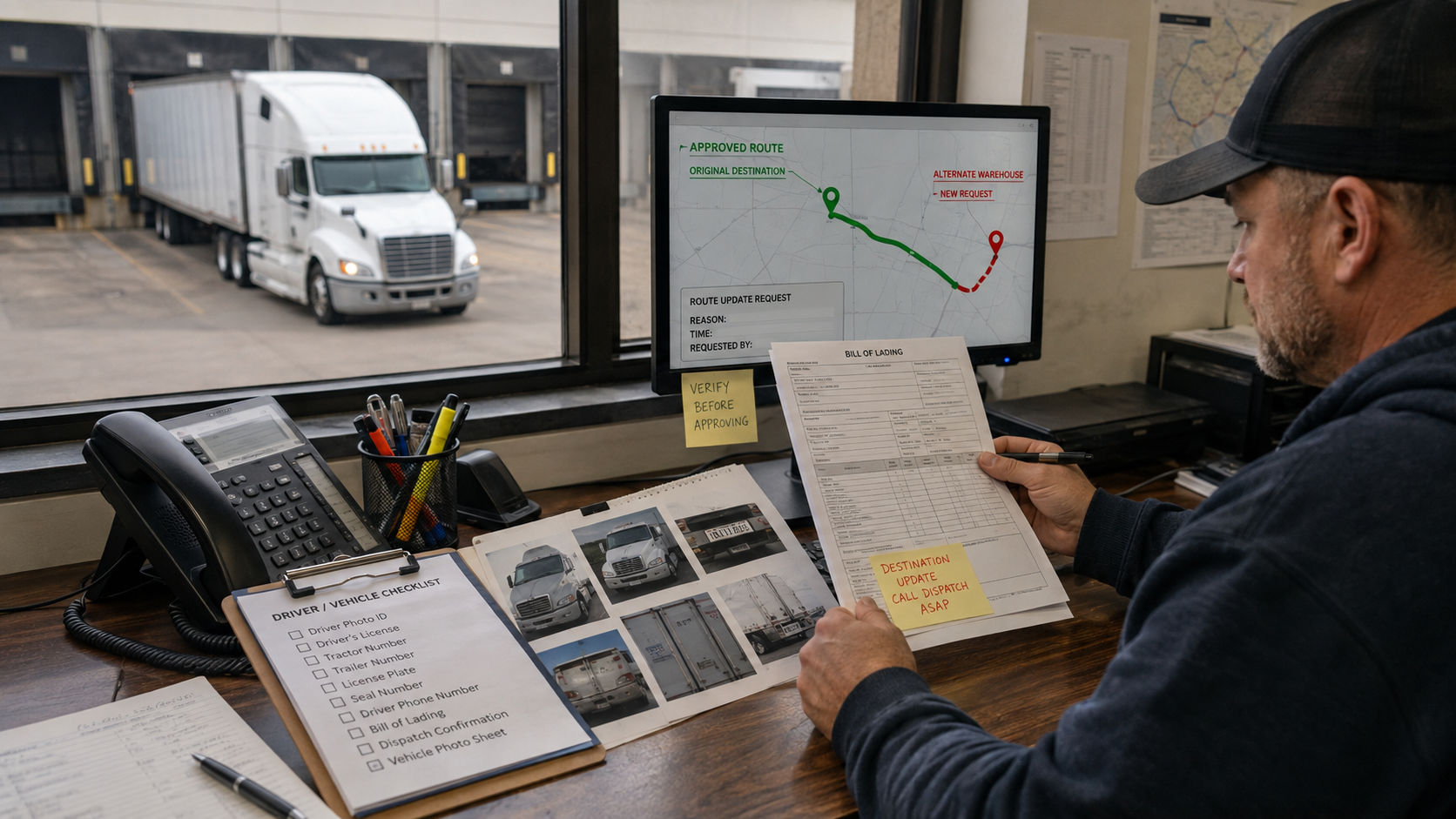
That is exactly when people start explaining away the mismatch.
“Probably just a typo.”
“They switched trucks.”
“The dispatcher said it was okay.”
“We’ve already wasted 20 minutes.”
That is how one bad clue gets waved through.
Then the Route Changes
This is the part I would make very difficult.
A destination change should not be treated like an ordinary dispatch update.
It should restart verification.
If a driver gets a text saying:
“New warehouse. Deliver here instead.”
That should not be enough.
If an email arrives saying the consignee changed, also not enough.
If someone calls from a number you have never seen before and says, “I’m with dispatch,” still not enough.
Use a number you already trust.
Call the broker.
Call the carrier.
Call the shipper.
Verify the change independently.
And document who approved it.
The question is not, “Does this new instruction look believable?”
The question is:
Can I prove it came from someone who is actually authorized to change the load?
Very different standard.
Look at the Dock Record
If the freight disappears, investigators are going to start rebuilding the handoff.
I would want to know exactly what left your property.
Driver name.
Driver’s license.
Tractor number.
Trailer number.
License plates.
Seal number.
Carrier.
Broker.
Pickup time.
Photos.
Bill of lading.
Phone number used for verification.
Who released the load.
Who called whom.
That may sound excessive right up until a $300,000 load goes missing.
Then everybody wants those records.
The FBI recommends keeping this type of documentation for a reason.
If you have a clean handoff record, you have somewhere to start.
If your records say only “picked up Tuesday,” you have almost nothing.
Watch for the Story Changing
Here is another clue I would pay attention to.
The story changes.
The original carrier cancels.
A replacement appears almost immediately.
Then the truck changes.
Then the driver’s phone number changes.
Then the destination changes.
Then someone says the warehouse closes early, so the load has to move now.
Any one of those could be legitimate.
Stack them together and I am slowing the load down.
That is how fraud usually looks in real life.
Not one giant flashing warning.
Several little things that are almost believable.
Almost.
Email Can Be Part of the Setup
Sometimes the criminal does not need to fake the company.
They get inside the real email account.
That is much harder to spot.
Now the message comes from the actual broker’s address.
The signature is right.
Old conversations are sitting underneath it.
The criminal may even know who normally approves the load.
That is why an email by itself cannot be the control.
The FBI has also warned about mailbox rules that can quietly forward, hide, or delete messages after an account is compromised.
So if you suddenly see odd forwarding rules, unusual logins, missing emails, or messages being marked read when nobody opened them, do not shrug it off as an IT problem.
That could be the beginning of the theft.
Cheap Inventory Can Be Evidence Too
The investigation does not necessarily end with the truck.
Eventually, stolen freight has to go somewhere.
So if you are a retailer, wholesaler, online seller, or small business being offered inventory at a price that makes absolutely no sense, ask why.
“Warehouse overstock.”
“Customer canceled.”
“Need to move it today.”
“Closeout deal.”
Maybe.
But price can be a clue.
If everybody else is selling something for $4,000 and someone offers you a truckload for $1,300 each, I would want to know exactly where those goods came from.
Who owns them?
Where did the seller get them?
Can they prove title?
Can they produce legitimate invoices?
A cheap deal gets expensive very quickly when the inventory turns out to be stolen.
Give Employees Permission to Stop the Truck
This may be the most important control.
Your employees have to know they are allowed to stop a load.
If the company culture says:
“Don’t hold up the dock.”
“Keep the trucks moving.”
“Don’t upset the customer.”
“Just get it out the door.”
then all your fraud training disappears the minute something does not match.
You want the opposite.
Wrong truck number?
Stop.
Unverified reroute?
Stop.
Driver information does not match?
Stop.
Someone suddenly wants the load after hours?
Stop and verify.
You can always release the shipment five minutes later.
Getting it back after it disappears is a much harder problem.
The Gate May Be the Crime Scene
Modern cargo theft does not always begin with bolt cutters.
Sometimes it begins with an email.
A login.
A phone call.
A convincing driver.
A last-minute change.
And an employee who does not want to be the person holding up the truck.
That is why verification matters so much.
The criminal does not necessarily need to break into your warehouse.
If the paperwork looks good enough, you may open the gate for them.
So when one piece of the story changes, do not ask whether the explanation sounds reasonable.
Ask whether you can prove it.
Because once that truck turns out of the driveway, the case gets a lot harder.
