
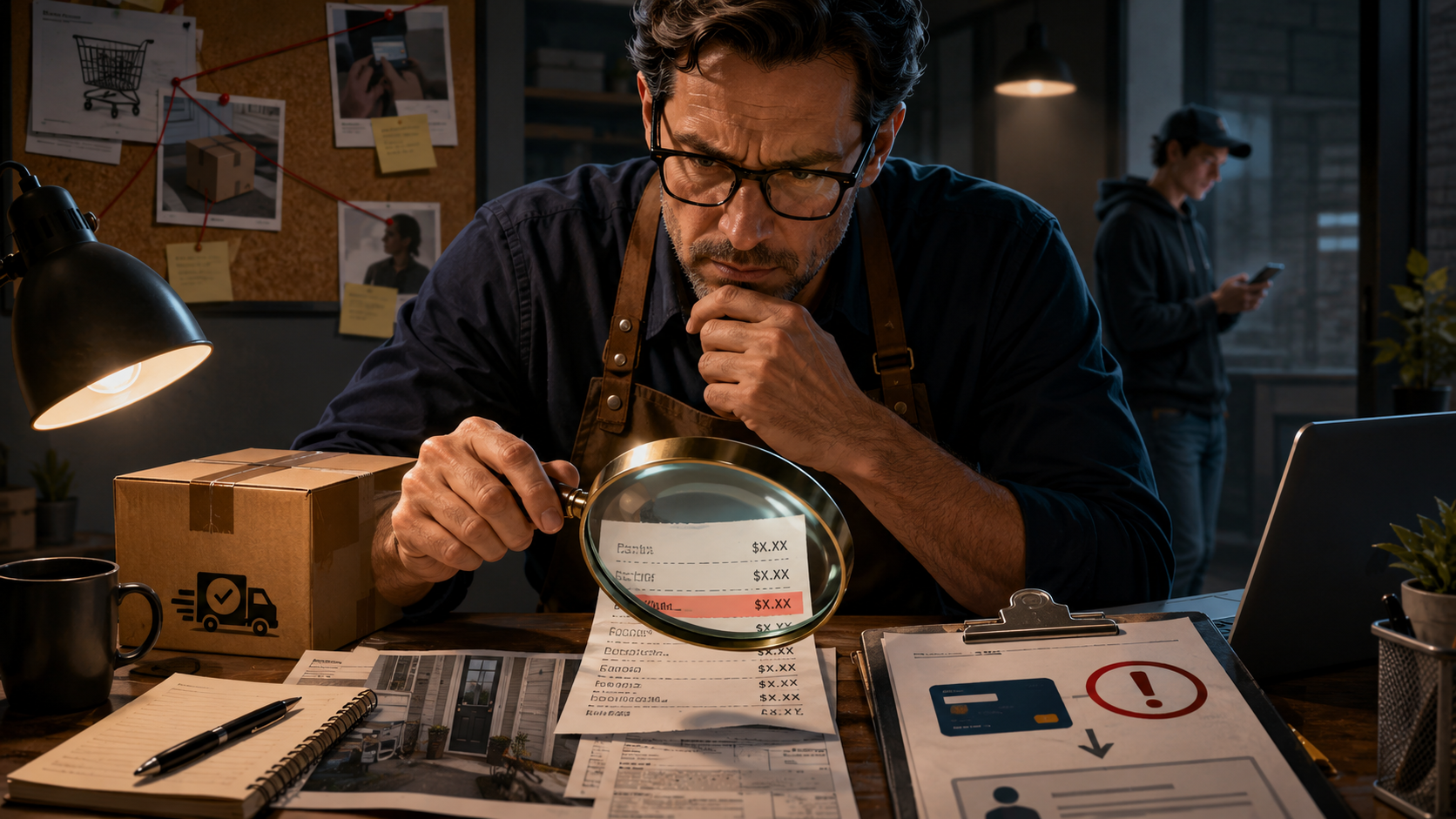
Most small business owners know the usual fraud suspects.
The fake invoice.
The stolen credit card.
The weird email with a link you absolutely should not click.
The “vendor” who suddenly changed their bank account.
That kind of fraud makes sense. It comes from the outside.
But there is another kind that feels a lot messier because the person causing the problem may not look fake at all.
They may be a real customer.
Real name.
Real card.
Real order.
Real delivery.
Real service.
And then, after everything is done, they go to the bank and say something different happened.
That is first-party fraud.
And no, I do not love the term “friendly fraud.” There is nothing friendly about doing the work, shipping the order, or delivering the service, then having the money pulled back because the customer filed a dispute.
The part nobody likes to talk about
Here is the uncomfortable part.
Sometimes the customer is confused.
Sometimes they truly do not recognize the charge. Maybe the name on the bank statement does not match the name on your website. Maybe their spouse used the card. Maybe they forgot they signed up for something.
That happens.
But sometimes?
They know exactly what they bought.
They know they received it.
They know they used it.
And they dispute it anyway.
That is the part that makes first-party fraud so hard for small businesses. You are not looking for a hacker in a hoodie. You are looking at someone who may have passed every fraud check because, at the time of purchase, they looked completely normal.
The problem shows up later.
After the sale.
After the delivery.
After the service.
After your team has moved on.
This is where the case starts
A customer buys something.
No red flags.
The payment clears.
The product ships or the work gets done.
Then the chargeback comes in.
The customer says:
“I never authorized this.”
“I did not receive it.”
“I cancelled.”
“I did not agree to those terms.”
“I already asked for a refund.”
Now you have to prove what happened.
Not what you remember happened.
Not what your employee thinks happened.
Not what “should be obvious.”
What you can prove.
That is the part many small businesses are not ready for.
They did the right thing, but the proof is scattered all over the place.
Receipt in one system.
Tracking in another.
Emails in the inbox.
Text messages on someone’s phone.
Refund notes in someone’s head.
Policy buried on the website.
That is not a case file.
That is a junk drawer.
And when the bank asks for evidence, a junk drawer is not your friend.
The sale is not always the crime scene
With regular payment fraud, you usually look at the front end.
Was the card stolen?
Does the address match?
Is the order strange?
Is the customer rushing?
Is the shipping address suspicious?
With first-party fraud, the sale itself may look fine.
The fraud may be in the story told later.
That is the twist.
The customer may have received the item and then claimed they did not.
They may have used the service and then said they never approved the charge.
They may have missed the cancellation window and decided to call it fraud instead.
They may have asked you for a refund and disputed the charge at the same time.
That is why the paper trail matters so much.
The paperwork is not busywork.
It is the witness.
The tiny clues that matter later
This kind of fraud usually does not announce itself with flashing lights.
It shows up in small details.
A customer has disputed before.
A shipping address keeps appearing in problem orders.
A customer claims “not received” more than once.
Someone waits until the refund window closes, then files a dispute.
A subscription customer logs in for months, then says the charge was unauthorized.
A custom order is approved, completed, delivered, and then disputed.
One of those things by itself might be nothing.
But more than one?
Now you have a pattern.
And patterns matter.
Small businesses are often so busy putting out fires that nobody stops to ask, “Have we seen this name before?” or “Is this the same address from that other dispute?” or “Why does this product keep getting charged back?”
That is where money leaks out.
Not always in one huge dramatic theft.
Sometimes it is $200 here, $700 there, $1,500 next month, and nobody connects the dots.
Your billing name can make the mess worse
This is one of those boring details that can cause a real problem.
The customer buys from “Smith’s Outdoor Supply.”
But their card statement says “SOS Holdings LLC.”
They look at it and think, “I have no idea what this is.”
Then they dispute it.
Was that fraud? Maybe not.
Was it preventable? Probably.
If the name on the customer’s statement is not obvious, fix it if you can. If you cannot fix it, tell them ahead of time.
Put it on the receipt.
“Your statement will show this charge as SOS Holdings LLC.”
Simple.
Not glamorous.
But neither is losing a chargeback because your own billing descriptor looked suspicious.
Do not rely on memory
Memory is not evidence.
That sounds harsh, but it is true.
“I remember talking to her” is not the same as an email.
“He approved it on the phone” is not the same as a signed estimate.
“She knew it was nonrefundable” is not the same as a written policy she accepted.
“They picked it up” is not the same as pickup proof.
If a customer later changes the story, your business needs something stronger than “that is not what happened.”
You need the record.
For product sales, keep the receipt, order details, delivery proof, and customer messages.
For service work, keep the signed estimate, scope, approvals, completion notes, and payment terms.
For subscriptions, keep the sign-up date, terms, renewal notices, cancellation instructions, and usage history.
Nothing fancy.
Just enough that somebody who knows nothing about the transaction can open the file and understand the story.
Refunds need notes
Refunds are where things get sloppy fast.
A customer complains.
Someone makes an exception.
Someone promises to “look into it.”
Someone offers a replacement.
Someone says, “We can do a partial refund.”
Then three weeks later, the customer disputes the charge.
Now everyone is trying to remember what was said.
That is a problem.
Every refund decision needs a note.
Date.
Who handled it.
What was offered.
What was approved.
What was denied.
Why.
Not a five-page memo.
Just a clear note.
Because when the dispute comes in, the person responding may not be the person who had the original conversation.
When the dispute hits, do not get emotional
I get it. Chargebacks can feel personal.
Especially when you know the customer received the product or used the service.
But the response cannot sound like you are mad.
The bank does not need your frustration.
It needs the facts.
Send the receipt.
Send the proof of delivery.
Send the signed agreement.
Send the terms.
Send the emails.
Send the refund policy.
Send the timeline.
Make it easy to follow.
Think less “angry business owner” and more “detective handing over the case file.”
Here is what they bought.
Here is what they agreed to.
Here is when they received it.
Here is what they said.
Here is why the dispute does not match the record.
That is how you fight back.
But do not call every dispute fraud
This is where business owners have to be careful.
A dispute does not automatically mean the customer is lying.
Sometimes the business made it confusing. Sometimes the receipt was vague. Sometimes the cancellation policy was buried. Sometimes the billing name looked strange. Sometimes customer service dropped the ball.
If the dispute points to a real problem, fix the problem.
Fraud prevention is not about treating every customer like a suspect.
It is about making sure dishonest customers cannot use your messy process against you.
Big difference.
The Detect-a-Fraud takeaway
First-party fraud is sneaky because it can start as a normal sale.
The customer looks real because they are real.
The card works because it is their card.
The order looks fine because it may be fine.
Then later, the story changes.
That is why small businesses need records that can tell the story without you standing there explaining it.
Clear receipts.
Recognizable billing names.
Written approvals.
Delivery proof.
Refund notes.
Subscription terms.
A way to spot repeat disputes.
You do not need to become paranoid.
You do need to stop relying on memory, scattered messages, and “we know what happened.”
Because when a customer changes the story, your records need to be able to say:
No. Here is what actually happened.
