
Fraud does not always look like fraud.
Sometimes it looks like a check run.
A vendor payment.
A reimbursement.
A normal Tuesday in the accounting office.
That is the problem.
The money does not always disappear in one loud, obvious moment. Sometimes it leaves quietly. One check at a time. One entry at a time. One “everything looks fine” report at a time.
By the time someone notices, the trail is cold, the records are messy, and the number is a whole lot bigger than anyone expected.
That is what makes a recent case out of Kansas worth looking at.
According to reporting from Hays Post and KWCH, federal prosecutors accused a former controller at an agricultural cooperative in Colby, Kansas, of embezzling more than $750,000 from her employer.
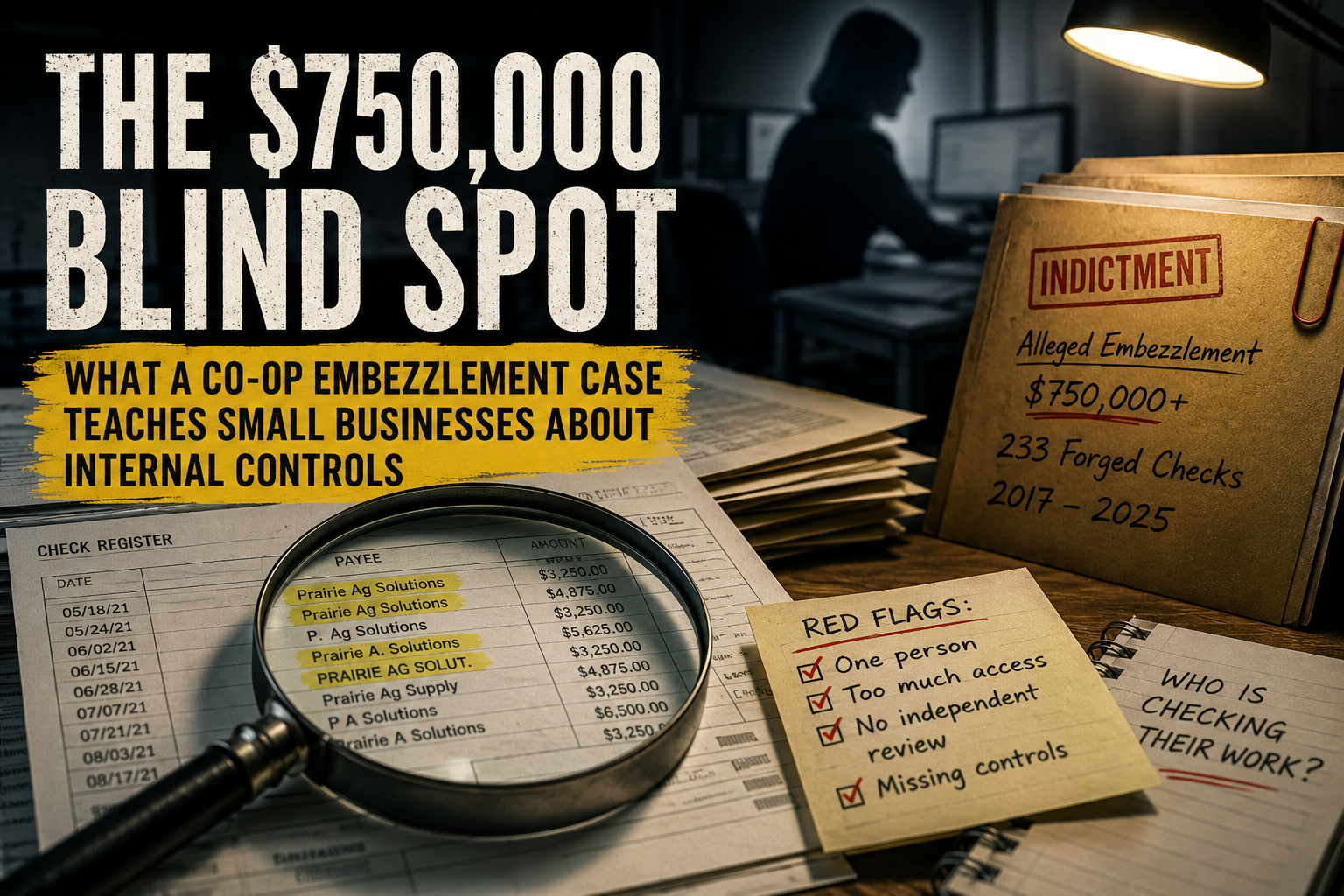
The indictment claims she forged 233 checks between January 2017 and November 2025. Prosecutors say the checks were deposited into her personal bank account, coworkers’ signatures were used without their knowledge, and accounting records were changed so the payments looked legitimate.
Important note: this is still an allegation. The defendant has not been proven guilty.
But even at the allegation stage, the case gives small business owners a very clear lesson.
The weak spot was not just the checkbook.
It was the system around the checkbook.
The First Clue: Too Much Control in One Chair
When fraud investigators look at a case like this, they are not just asking, “Who stole the money?”
They are asking a better question.
“How was this possible for so long?”
That is where small businesses need to pay attention.
In this case, the accused employee reportedly had a lot of control inside the accounting department. She supervised accounting. She processed payments. She reconciled bank accounts. She entered purchases and expenses into the general ledger.
That means one person allegedly had access to three things:
The money.
The bank records.
The books explaining where the money went.
That is not a small detail.
That is the whole case file.
When one person can create a payment, record the payment, and reconcile the bank account, the business is trusting that same person to check their own work.
And listen, most people are honest.
But internal controls are not built for “most people.”
They are built for the moment someone is under pressure, sees an opening, and realizes nobody is looking.
That is when fraud gets its first invitation.
The Dangerous Triangle
Here is the setup every small business owner needs to watch for.
One person can move money.
That same person can enter the transaction in the books.
That same person can reconcile the bank account and mark everything as cleared.
That is the dangerous triangle.
Because if a bad payment is made, the person who made it can also be the person who explains it away.
A fake vendor payment can be coded to supplies.
A personal payment can be buried in reimbursements.
A forged check can be entered like a regular expense.
A strange transaction can disappear into “miscellaneous” where nobody goes looking unless something already feels wrong.
And by then?
You may be years into the problem.
Small Businesses Get Comfortable. Fraud Loves Comfortable.
Most small businesses do not get hit because their accounting is too complicated.
They get hit because the process becomes too familiar.
The same person has always handled it.
The reports always show up.
The bank account reconciles.
The bills get paid.
The owner is busy running the business, dealing with customers, managing employees, putting out fires, and trying to make payroll.
So nobody opens the check images.
Nobody looks at the payee names.
Nobody asks why the same expense account keeps getting used.
Nobody compares the vendor list to the payments going out.
Nobody wants to make the trusted employee feel questioned.
And that is exactly where fraud settles in.
Not in chaos.
In routine.
The Clues Hiding in the File
Long-running fraud usually leaves clues.
The problem is that the clues are boring.
They do not wave their arms and shout.
They sit quietly inside the bank statement, the check register, the vendor list, and the general ledger.
Look for things like:
One employee handling payments, reconciliations, and ledger entries without review.
Checks written to employees, unfamiliar vendors, or names that do not quite make sense.
Vendor names that are almost right, but not exactly right.
Payments coded again and again to vague accounts like supplies, repairs, reimbursements, or miscellaneous.
Missing check images.
Signatures that look a little off.
Payments approved outside the normal process.
Bank reconciliations that are completed every month but never actually reviewed.
An employee who does not want anyone else touching the books.
An employee who avoids vacations because “nobody else knows how to do it.”
That last one matters.
When someone cannot step away without the whole process falling apart, you do not just have an operations issue.
You may have a control issue.
The Ledger Is Not Just for Taxes
A lot of business owners look at the general ledger like it is some accounting thing they only need at tax time.
Wrong.
The ledger is the story of your money.
And if money is missing, the ledger may be the first place the story starts to crack.
Do not stop at the profit and loss report.
That is the polished version.
Fraud likes polished reports.
You need the transaction detail.
Open the expense account. Look at what is inside. Who got paid? When? For how much? Was it normal? Was there backup? Did the payee match the vendor? Did the check image match the entry?
Ask the basic detective questions:
Who approved this?
Why was it paid?
What was purchased?
Where is the invoice?
Does this vendor actually exist?
Why is this payment coded here?
Why are there so many round numbers?
Why is this amount just under the approval limit?
None of those questions require an accounting degree.
They require curiosity.
And curiosity is a fraudster’s least favorite business habit.
This Is Not About Distrusting Your Bookkeeper
Let’s be clear.
The lesson here is not “never trust your bookkeeper.”
That is not the point.
The point is that good people deserve good systems.
A strong control process protects the owner, the business, and the honest employees doing the work.
Because when there are no controls, everyone is exposed.
The owner is exposed to loss.
The employee is exposed to suspicion.
The business is exposed to damage.
And if something goes wrong, nobody can prove what happened quickly because the paper trail is weak.
Controls are not about hovering.
Controls are about being able to say, “Show me the trail.”
Approval.
Payment.
Bank clearing.
Ledger entry.
Backup.
If the trail is clean, great.
If the trail depends entirely on one person saying, “Trust me,” that is not a control.
That is a blind spot.
Separate the Money From the Story
The basic rule is simple.
The person moving the money should not be the only person telling the story of where the money went.
That means, whenever possible:
One person prepares payments.
Another person approves them.
One person enters bills.
The owner reviews new vendors and vendor banking changes.
One person reconciles the bank account.
Someone else reviews the bank statement and check images.
The owner has direct access to the bank account.
Payroll changes, reimbursements, and payments to insiders get a second look.
Now, I know what happens in small businesses.
You may not have three people available to split every accounting task perfectly.
Fine.
Then add a second look somewhere else.
Have the owner review the bank statement each month.
Have an outside accountant spot-check reconciliations quarterly.
Run a monthly report showing all payments over a set dollar amount.
Review every payment to an employee, owner, or unfamiliar vendor.
Require approval before any new vendor gets paid.
This is not about making the process slow.
It is about making sure money cannot leave the business and get explained away by the same person.
What to Look at Every Month
You do not need to review every single transaction like you are preparing for a federal trial.
But you do need a monthly review habit.
Start here:
Open the bank statement directly from the bank.
Look at check images.
Review ACH withdrawals.
Review wires.
Review debit-card transactions.
Look at payments to employees.
Look at payments to new vendors.
Look at reimbursements.
Look at anything coded to miscellaneous.
Look at large round-dollar payments.
Look at payments just under approval limits.
Look at any vendor name you do not recognize.
Then ask questions.
Not angry questions.
Not accusatory questions.
Just normal business-owner questions.
“What was this for?”
“Who approved this?”
“Can you send me the backup?”
“Why was this coded here?”
That kind of review changes behavior fast.
Because once people know someone is looking, the system gets stronger.
The Case File Lesson
The Kansas co-op case is still working its way through the legal system.
But the control lesson is already clear.
A business can have a trusted employee, clean-looking reports, and monthly reconciliations and still have a serious problem if nobody independent is reviewing the money trail.
That is the part small business owners cannot ignore.
Fraud does not need a complicated hiding place.
Sometimes it just needs one person with too much access and no second set of eyes.
The Detect-A-Fraud Takeaway
Trust is not the problem.
Blind trust is.
You do not need to run your business like everyone is a suspect. But you do need to run it like the money matters.
Because it does.
Someone outside the payment process should be able to follow the trail from approval to payment to bank clearing to ledger entry.
If they cannot, you have a blind spot.
And blind spots are where fraud learns the layout of your business, gets comfortable, and starts taking money one quiet transaction at a time.
