
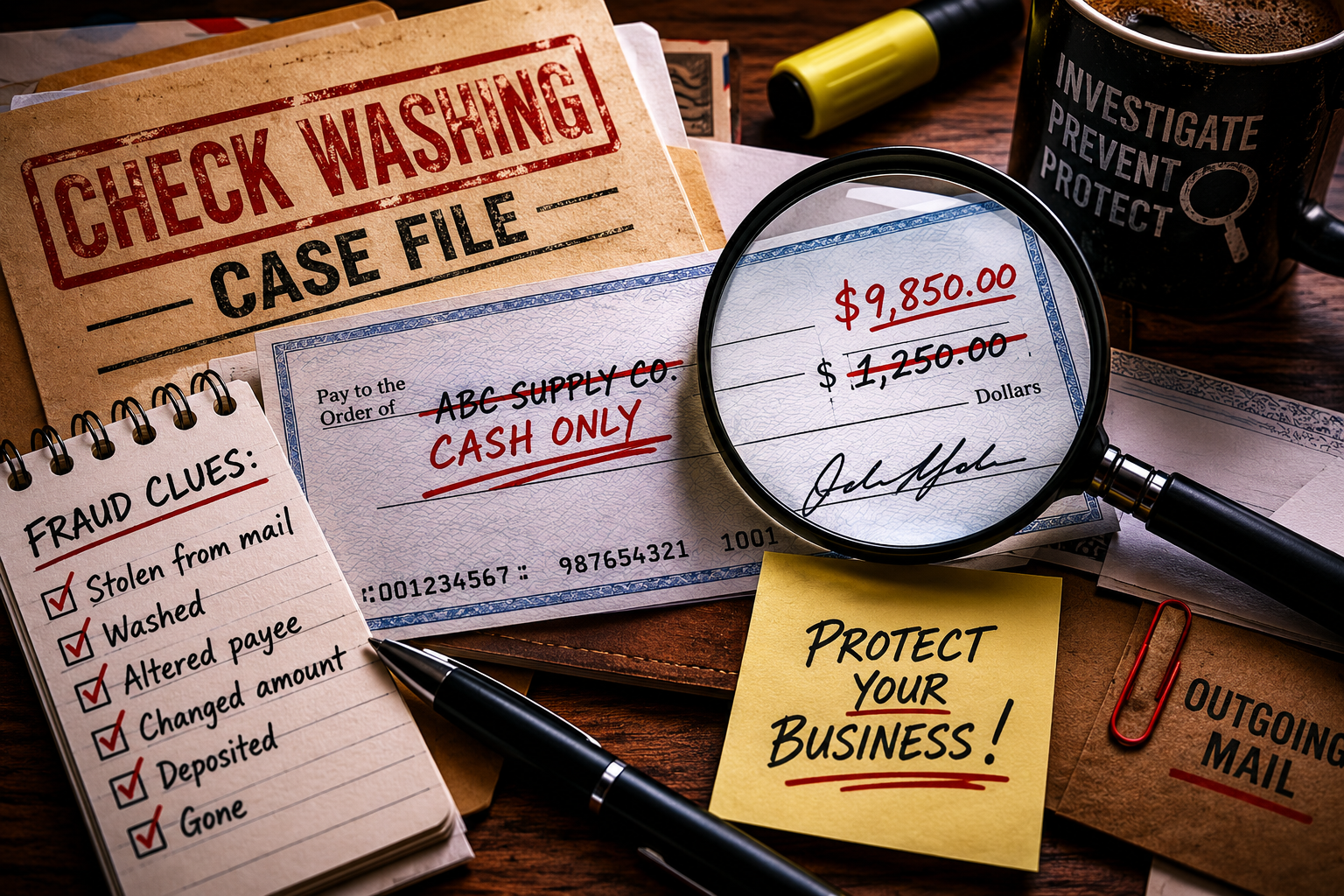
The check looked harmless.
That is usually how these things start.
A business owner writes it. Maybe it is for rent. Maybe insurance. Maybe a vendor who still insists on paper checks because “that is how we have always done it.”
The check goes in an envelope.
The envelope goes in the mail.
Everybody moves on.
Except the check never makes it where it was supposed to go.
Somewhere between the mailbox and the bank, somebody gets their hands on it. They wash it, change the name, maybe change the amount, and deposit it like it belongs to them.
By the time the real vendor calls and says, “We never got paid,” the money is gone.
And now the business owner has two problems.
The vendor still wants their money.
The bank account already took the hit.
That is the part people do not always understand about check fraud. It is not just the stolen money. It is the mess left behind.
The old scam that never really left
Check washing sounds like something from a crime show your parents watched.
It is not.
It is happening now.
And it works because paper checks still have one big weakness: they leave your control.
Once that envelope is out of your hands, you are trusting every stop along the way. The mailbox. The mail carrier. The sorting facility. The recipient’s mailbox. Their front desk. Their accounting department.
That is a long trail.
And fraudsters love a long trail.
They only need one weak spot.
Why small businesses get caught
Big companies usually have layers.
They have bank controls. Payment approvals. Positive pay. Treasury people. Daily cash monitoring. A finance team that notices when something smells off.
Small businesses usually have Brenda.
Brenda prints the checks, stuffs the envelopes, takes them to the mailbox, enters the bills, answers the phone, reconciles the account, and somehow knows where the extra toner is.
Brenda is not the problem.
The problem is that the whole system depends on one person being busy, careful, available, and never interrupted.
That is not a fraud prevention plan.
That is a wish.
And wishes do not stop stolen checks.
Here is where the trail goes cold
The business thinks the bill is paid.
The vendor thinks the business is late.
The bank sees a cleared check.
The accounting system says everything is fine.
But everything is not fine.
That is the danger. On paper, the books may look clean. The check cleared. The transaction posted. The bank balance changed. Nothing screams fraud.
Until somebody asks the one question that cracks the case open:
“Who actually received the money?”
That is the question small businesses need to ask more often.
Not just, “Did the check clear?”
That is not enough.
A stolen check can clear.
A washed check can clear.
A fraudulent deposit can clear.
Cleared does not mean correct.
The clues business owners should watch for
Check fraud usually leaves a few fingerprints.
A vendor says they never received payment.
A check clears for more than expected.
The payee name on the cleared check image does not match the vendor.
A check clears unusually fast.
A check number is missing.
Two checks clear with similar amounts.
A payment clears, but the vendor balance still shows open.
A bank transaction looks normal at first glance, but the check image tells a different story.
That last one matters.
Do not just look at the bank feed. Look at the check image.
The image is where the evidence is.
How to make your checks harder to steal
The best move?
Write fewer checks.
I know. Not glamorous. Not complicated. Not some high-tech fraud tool.
But it works.
Use ACH when you can. Use your bank’s bill pay. Use a credit card when it makes sense. Ask vendors if they can take electronic payments. Many businesses keep writing checks because nobody has bothered to change the habit.
And fraud loves a habit.
For the checks you still have to write, put controls around them.
Use positive pay
Positive pay is one of those bank tools that sounds boring until it saves you thousands of dollars.
You give the bank a list of checks you actually issued. Check number. Amount. Payee.
If someone tries to deposit a check that does not match, the bank flags it.
Think of it like the doorman at a private club.
If the check is not on the list, it does not just stroll in.
Review your bank account daily
Monthly is too slow.
By the time month-end rolls around, the money may be long gone, the vendor may be angry, and the bank investigation may be harder.
Someone needs to look at bank activity every business day.
Not for an hour. Not with a magnifying glass and a trench coat.
Just look.
What cleared?
Who got paid?
Does the amount make sense?
Does the check image match the bill?
Is anything out of sequence?
Five minutes a day can catch what five weeks of silence can bury.
Stop using the mailbox like a vault
Your outgoing mailbox is not secure.
That little red flag is not a notification system. It is an advertisement.
If you have to mail a check, take it inside the post office. Do not leave it sitting in a curbside mailbox overnight. Do not mail checks before a holiday weekend if you can avoid it. Use security envelopes so the check is not obvious.
This is basic crime-scene prevention.
Do not leave the evidence where anybody can grab it.
Separate the steps
Even tiny businesses can separate duties.
One person can prepare the payment.
Another person can approve it.
Someone else can review what cleared.
That does not mean hiring a full accounting department. It means not letting one person own the entire money trail from bill to bank statement.
Fraud gets comfortable in the dark.
Turn on a second light.
Check the check images
This is the step most businesses skip.
They reconcile the bank feed. They see the check cleared. They move on.
Do not move on.
Open the image.
Look at the payee. Look at the endorsement. Look at the amount. Compare it to the bill.
Yes, it takes a minute.
So does locking your front door.
What to do if the check is already gone
If you suspect a check was stolen or washed, move quickly.
Call the bank first. Ask what can be disputed and what documents they need.
Pull the check image.
Notify the vendor.
File a police report if the bank requires it.
Report mail theft if the check was stolen from the mail.
Document every call, every date, every person you spoke to, and every case number.
This is not the moment for “I’ll deal with it later.”
Later is how fraud gets expensive.
The real lesson
Check washing is not clever.
That is what makes it so irritating.
It is simple. It is quiet. And it works because small businesses are busy.
A thief does not need to hack your system if your payment process has gaps big enough to walk through.
So here is the question:
If someone stole one of your checks today, how fast would you know?
If the answer is “at month-end,” that is too late.
Start with one thing.
Call your bank and ask about positive pay.
Then look at how checks move through your business, from the moment a bill is approved to the moment the money clears.
Follow the trail.
That is where the clues are.
