
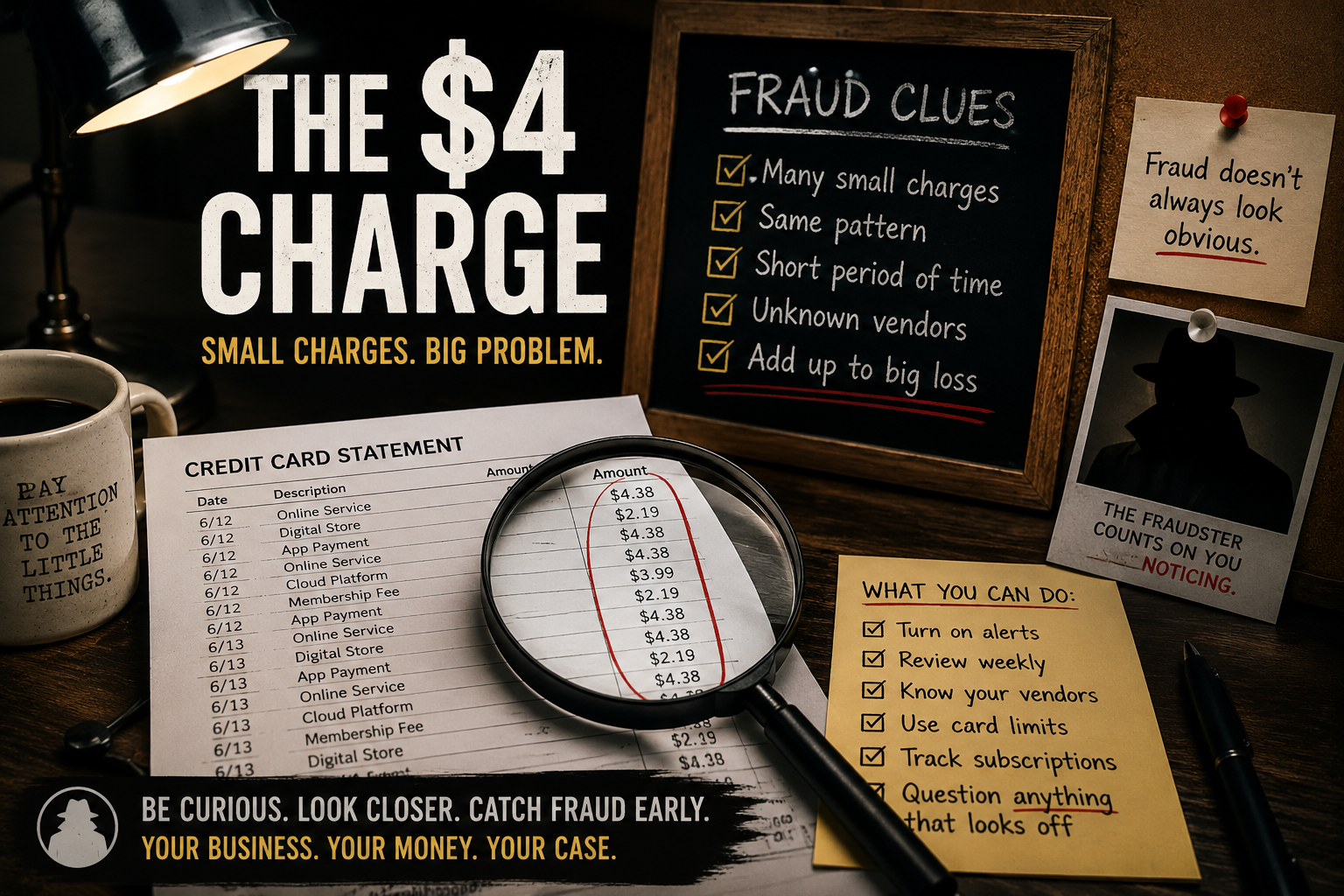
A $4 charge does not look like fraud.
It looks like coffee. Or an app. Or some random thing someone bought online and forgot to mention.
That is what makes it dangerous.
There was a Washington Post story recently about a woman who found more than 1,700 charges on her credit card that she did not make. Not 17. Not 70. More than 1,700.
Most of them were tiny.
A few dollars here. A couple dollars there. One of those charges you see on a statement and think, “I’ll figure that out later.”
Except “later” is exactly where fraud likes to hide.
By the time all those little charges were added up, the total was close to $8,000.
That is not a small mistake. That is a financial crime scene.
And small businesses need to pay attention, because this same thing can happen on a company card before anyone realizes what is going on.
The First Clue Is Usually Boring
Everybody expects fraud to look dramatic.
A giant wire transfer.
A fake vendor.
A missing check.
A bookkeeper suddenly buying a boat.
But a lot of fraud is boring.
That is the trick.
It slips in through the side door dressed like a normal business expense. A $3.99 charge. A $4.38 charge. Something from a vendor name that sounds vaguely familiar. Something that could be software, shipping, an online tool, an app, a subscription, or a purchase someone forgot to code correctly.
And in a small business, there is already plenty of noise.
The owner is busy. The office manager is busy. The bookkeeper may be looking at the transaction weeks later and trying to guess what happened. Someone says, “That’s probably fine,” and everyone moves on.
That is how a tiny charge gets away with it.
The Statement Is Not the Alarm System
A lot of businesses still rely on the monthly credit card statement as their main review tool.
That is a problem.
A statement tells you what already happened. It does not protect you while it is happening.
In the story, the charges hit over three days.
Three days.
If your business only reviews card activity when the statement closes, you are giving a fraudster a lot of room to work. By the time anyone notices, the card may have been hit dozens, hundreds, or even thousands of times.
Then the owner is stuck doing the least fun kind of detective work.
Which charges were real?
Which ones were fake?
Who had the card?
Which subscriptions need to be updated?
Did the bank reverse everything?
Did the bookkeeper already categorize some of it?
Is cash flow going to be tight because of this?
That is not a quick cleanup. That is a mess.
Follow the Pattern, Not Just the Amount
Here is where business owners need to think like detectives.
Do not just ask, “Is this charge big?”
Ask, “What is the pattern?”
One $4 charge may not tell you much.
But six charges from the same strange vendor?
Twenty charges in one afternoon?
A bunch of tiny charges from companies no one recognizes?
Multiple charges just under a threshold?
Now we have a clue.
Fraudsters often test a card with small transactions. If the card works, they keep going. They are hoping the business is too busy, too trusting, or too disorganized to notice.
And honestly, that bet pays off more often than it should.
Not because business owners are careless. Most are not.
It happens because no one built a simple system to catch the weird stuff early.
What I’d Tell a Small Business Owner To Do
Start with the easiest control first.
Turn on card alerts.
Not just alerts for big charges. Big-charge alerts would not have caught this kind of problem early enough. You need alerts for online purchases, card-not-present charges, declined transactions, international activity, and ideally every transaction on the card.
Will it be annoying for a few days? Probably.
But you know what is more annoying? Spending hours on the phone with the bank trying to explain why 1,700 charges are not yours.
Next, review the card activity every week.
Not once a month. Weekly.
This does not have to be some big formal meeting with spreadsheets and dramatic music. Pull up the card activity and look at it.
Do you recognize the vendor?
Does the amount make sense?
Is the charge repeating?
Does anyone know what it was for?
Does this vendor belong on the subscription list?
If the answer is “I don’t know,” do not ignore it. That is where you start digging.
And please, for the love of clean books, keep a subscription list.
Every business thinks they know what subscriptions they have. Most do not.
Write them down. Vendor, amount, billing frequency, card used, who approved it, and what it is for.
Because when some weird little charge shows up, you should not have to play “software vendor or scammer?” from memory.
One Card for Everything Is Convenient. It Is Also Risky.
A lot of small businesses run everything through one credit card.
I understand why. It feels simple.
But when that card gets compromised, simple turns into chaos.
Now your subscriptions, travel, online orders, advertising, employee purchases, and maybe even client-related expenses are all tied to the same card that has to be replaced.
That is how one fraud issue becomes an operations problem.
A better setup is to separate cards by purpose when you can.
One card for subscriptions.
One card for online purchases.
One card for travel.
Employee cards with actual limits.
Virtual cards for vendors that offer them.
This is not about making life complicated. It is about containing the damage.
If one card gets hit, you want to shut down one part of the system, not the whole thing.
Do Not Treat Fraud Like a Customer Service Issue
This part matters.
If fraud hits your business card, do not just call the bank and assume it is handled.
Document everything.
Dates.
Amounts.
Screenshots.
Statement pages.
Case numbers.
Names of people you spoke with.
What they told you.
When they said they would follow up.
Treat it like a case file because that is exactly what it is.
When money is missing or disputed, memory is not enough. You need a trail.
And if the card number was compromised, replace the card. Do not leave it open and hope the fraudster gets bored. That is not a control. That is wishful thinking.
The Real Lesson
The scary part of this story is not just that the charges happened.
It is that they were small enough to be overlooked.
That is the lesson for small businesses.
Fraud does not always announce itself. Sometimes it whispers. Sometimes it shows up as a tiny charge with a boring name. Sometimes the first clue is not a dramatic loss, but a transaction that makes you say, “Wait, what is that?”
Pay attention to that feeling.
That little pause is your detective instinct.
So here is what I would do today.
Pull up every business credit card. Look at the last 30 days. Sort by vendor. Look for repeated small charges. Look for names you do not recognize. Look for anything that feels even a little off.
Then turn on alerts and make weekly review a habit.
Not because you are paranoid.
Because you are paying attention.
And in fraud prevention, paying attention is half the battle.
