
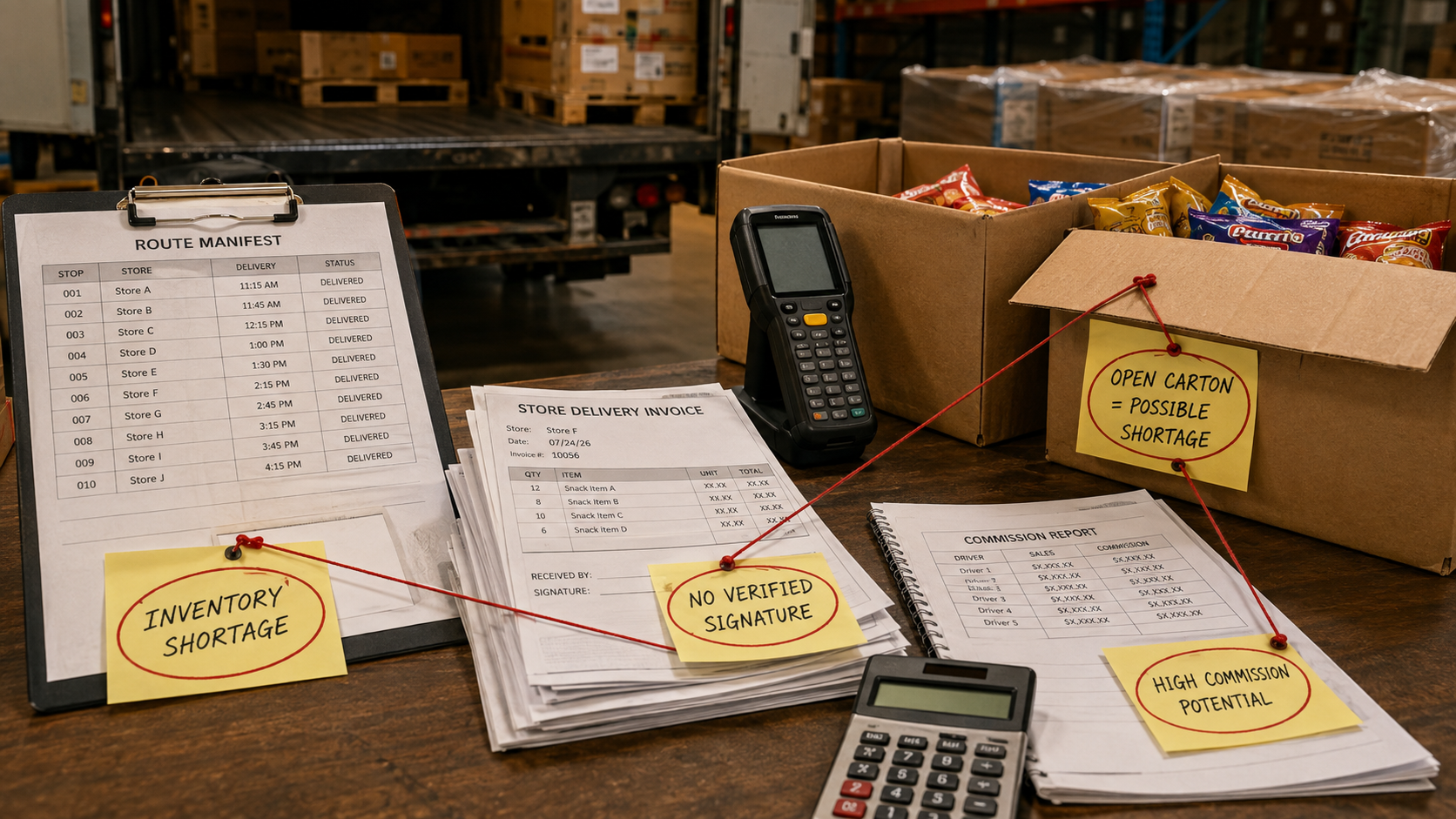
The Route-Sales Blind Spot: Inventory Left the Truck, but the Store Never Bought It
The product left the warehouse. The paperwork said it reached the stores. The cash allegedly took a different route.
Police in western Pennsylvania say a former delivery driver for Stewart Snacks, LLC sold Little Debbie products for cash at flea markets, then created false invoices showing that retail stores had purchased the inventory. The alleged scheme did more than conceal missing goods. It also generated commissions for sales the company says never happened.
Investigators identified more than $13,300 in false invoices from July through September 2025 and more than $3,700 in related commissions. The total alleged loss exceeded $17,100. The former driver was charged with forgery, theft by deception, theft by unlawful taking, deceptive or fraudulent business practices, and tampering with records or identification. The allegations have not yet been proven in court.
For a small distributor, wholesaler, bakery, beverage company, florist, parts supplier, mobile service business, or any operation that sends employees into the field with inventory, this case exposes a dangerous gap. If one employee controls the goods, the customer paperwork, and the sales record, a false invoice can make stolen inventory look like revenue.The Paper Trail Pointed at the Wrong Customer
The driver’s job reportedly included ordering, transporting, delivering, stocking, and servicing snack products at retail locations across Washington County. That is a practical route-sales model: one person moves the merchandise and maintains the customer relationship.
It is also concentrated control.
According to police, the distributor delivered products to stores and submitted invoices that the stores would pay. The driver earned a weekly commission based on sales in his territory. Investigators allege that products were sold for cash at flea markets while invoices were created in the names of retailers such as Shop ‘n Save, Giant Eagle, and Walmart.
On the company’s books, the route could appear productive. Inventory left the truck. An invoice explained where it went. The driver’s commission rose with the supposed sales.
But an invoice proves only that someone entered a transaction. It does not prove the customer ordered the goods, received them, or agreed to pay.
That distinction is the center of the case.One Employee Held Three Pieces of the Story
Fraud risk grows when the same person can answer all three questions with records they control:
- What inventory left the business?
- Which customer received it?
- How much commission should be paid?
The business needs an independent answer to at least one of those questions.
For route deliveries, that answer might come from a store employee’s verified receipt, a customer purchase order, direct electronic acceptance, a payment matched to the invoice, or an exception review performed by someone outside the route. The exact tool can vary with the size of the company. The principle does not: the person carrying the product should not be the only source proving the sale.
Paper signatures alone deserve caution. A signature can be copied, scribbled, or attributed to a person who never saw the delivery. For larger or unusual transactions, confirm the recipient’s name and store location and compare the delivery with the customer’s ordering history.The Clues Hiding in Ordinary Reports
This type of scheme may leave small inconsistencies before it produces a large shortage.
Watch for route sales that rise without a matching increase in customer payments. Review invoices that remain unpaid longer than the customer’s normal cycle. A store that never ordered the goods will not quietly pay the bill.
Look for unusual invoice concentration. If one driver reports a cluster of round-dollar sales, repeated product mixes, weekend activity, or transactions just below a review threshold, compare them with the rest of the route.
Compare inventory loaded, inventory returned, documented spoilage, and verified deliveries. Treat unexplained shrinkage as a question, not an automatic operating expense.
Review commissions that grow faster than collected sales. A commission plan based only on invoices can reward an entry before the customer confirms the transaction. When practical, base commissions on verified or collected sales, or hold back the portion tied to disputed and unpaid invoices.
Listen to customer complaints. A retailer questioning an invoice may be reporting more than a billing mistake. Several customers disputing transactions from the same route, driver, or period form a pattern that deserves escalation.Build a Four-Way Match for Route Sales
Accounts-payable teams use a three-way match to compare a purchase order, receiving record, and vendor invoice. A route-sales business can use a similar control from the seller’s side.
Match four pieces:
- Inventory released: What product and quantity were loaded onto the vehicle or assigned to the employee?
- Customer authorization: What order, standing agreement, or approved replenishment request supports the delivery?
- Proof of receipt: Who at the customer accepted the goods, where, and when?
- Financial result: Did the invoice enter the customer’s account and produce payment, a legitimate credit, or a documented dispute?
Not every small delivery needs a manager’s personal review. Use exception rules. Flag new customers, unusual quantities, manual invoices, handwritten changes, missing receipt data, disputed deliveries, high returns, and commission spikes.
The goal is not paperwork for its own sake. It is to prevent one document from explaining away missing property.Cash Sales Need Their Own Fence
The alleged flea-market sales in this case raise another issue: off-route cash.
If drivers are not permitted to sell inventory for cash, write that rule plainly and train employees on it. If cash sales are allowed, use pre-numbered receipts, same-day reconciliation, approved locations, inventory scanning, and deposit requirements. Do not leave the policy in a gray area where an unauthorized sale can be described as customer service or an informal promotion.
Supervisors should also understand secondary markets for the company’s goods. Flea markets, online marketplaces, social media listings, and reseller channels can reveal inventory moving outside approved customers. Occasional targeted checks may show patterns that the accounting system sees only as shrinkage.When the Numbers Stop Reconciling
Do not confront an employee before preserving the records needed to understand the loss.
Secure route manifests, invoices, commission reports, inventory counts, delivery-device records, customer complaints, vehicle assignments, and relevant communications. Limit access to records so they are not changed during the review. Contact selected customers independently and ask them to confirm specific deliveries.
Work with legal counsel, the insurer, and law enforcement as appropriate. Avoid presenting allegations as proven before the facts are established. The business still needs to protect evidence, employees, customers, and its own credibility.
Then look beyond the individual incident. Determine whether the same control gap exists on other routes or with other employees. A scheme can expose a process problem even when only one person is accused.The Case File Lesson
The alleged theft did not disappear because there was no paperwork. It disappeared because the paperwork supplied a cover story.
Inventory left company custody. False invoices allegedly assigned it to familiar retailers. The commission report made the activity look like successful selling. Each record supported the next until someone checked the supposed sales against the real customers.
For a small business, that is the preventive move: match what left your hands with independent proof of who received it and what they agreed to pay. If the only evidence of a sale comes from the person who benefits from recording it, the file is not closed.
