
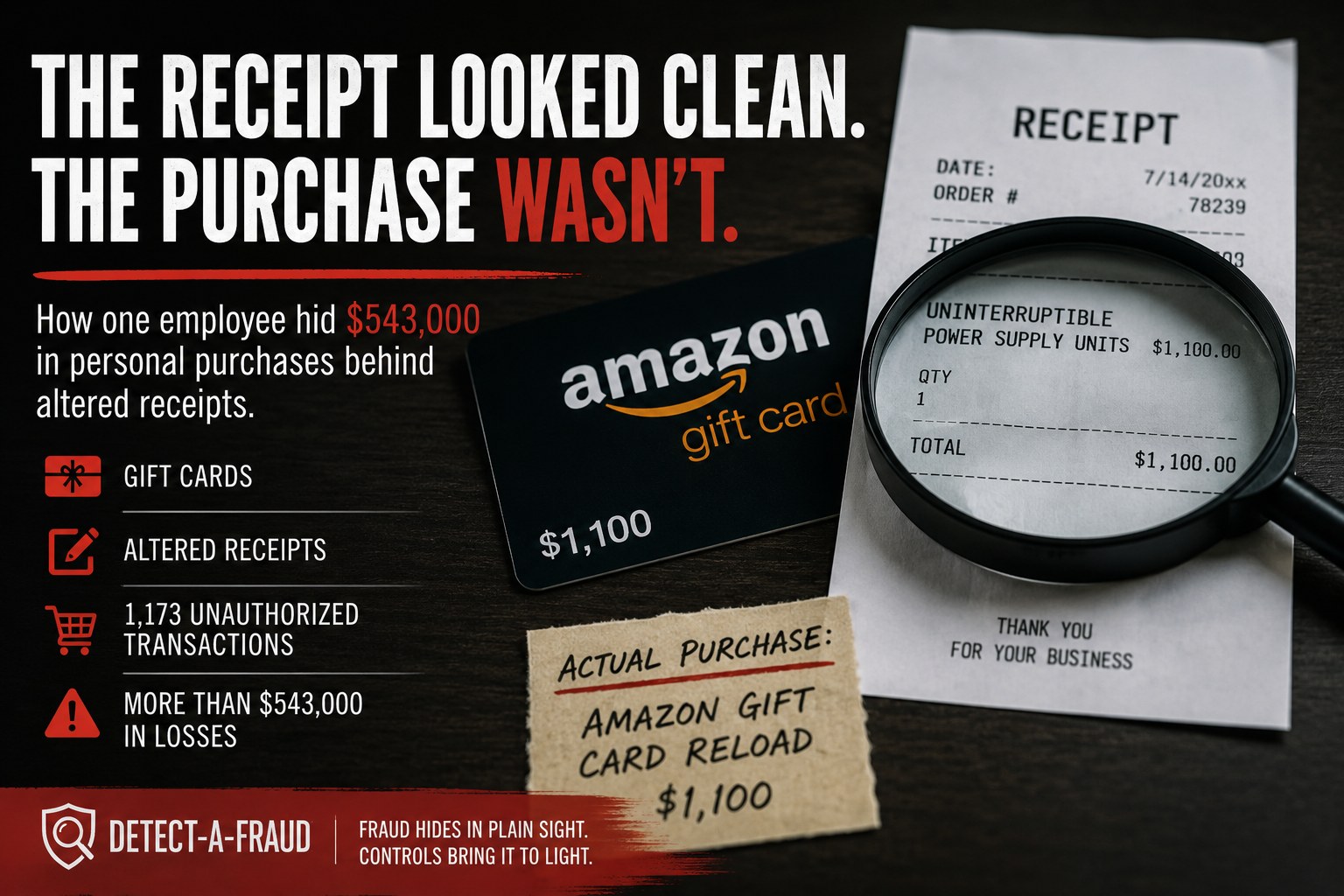
The receipt looked fine.
It had a vendor name. A date. An amount. A description that would not raise many eyebrows inside an IT department.
Uninterruptible power supply units.
Battery backups.
The kind of equipment a nonprofit’s technology director might reasonably buy.
Except that was not what he bought.
According to federal prosecutors, the actual purchase was an $1,100 reload to an Amazon gift card balance.
The receipt had been changed.
And that was only one transaction.
The Case
On July 21, 2026, the U.S. Attorney’s Office for the Southern District of Indiana announced the sentencing of Michael Meenan, the former Director of Information Services for an Indianapolis nonprofit.
Meenan pleaded guilty to wire fraud.
He was sentenced to 18 months in federal prison and ordered to repay $543,521.
He had worked for the nonprofit from 1999 until 2021.
That matters.
This was not a stranger who walked in off the street. He was a longtime employee with a real job, real responsibilities, and real access to the company credit card.
Part of his job was buying technology equipment.
That gave him a believable reason to shop at places like Amazon.
It also gave him cover.
Prosecutors said Meenan began using the company card for personal purchases as early as July 2007. The purchases included cameras, camera lenses, cycling equipment, gift cards, and Amazon gift card reloads.
Then he allegedly changed receipts so the purchases looked like legitimate business expenses.
By the end, prosecutors said there were approximately 1,173 unauthorized transactions.
More than half a million dollars gone.
Not in one transfer.
Not in one afternoon.
One charge at a time.
Source: U.S. Attorney’s Office, Southern District of Indiana, “Former Non-Profit IT Director Sentenced to Federal Prison for Nearly $550,000 Theft,” July 21, 2026.
What Would You Have Seen?
Probably nothing dramatic.
That is the problem.
You would have seen an employee credit card statement.
You would have seen charges from common retailers.
You would have seen receipts attached.
You may even have seen descriptions that sounded perfectly reasonable.
Technology equipment.
Office supplies.
Computer accessories.
The paperwork may have looked complete.
But complete paperwork and honest paperwork are not the same thing.
That is where this case gets interesting.
The fraud did not depend on nobody asking for receipts.
Receipts existed.
The fraud depended on nobody looking beyond them.
The Receipt Was the Disguise
Small businesses are often told to collect receipts.
That is good advice, but it is not enough.
A receipt tells you that something was purchased.
It does not tell you that the business needed it.
It does not tell you that the business received it.
It does not tell you that the description is true.
It does not tell you where the item ended up.
In this case, prosecutors said a gift card reload was made to look like battery backup equipment.
So the real question was never, “Is there a receipt?”
The real questions were:
Where are the battery backups?
Who received them?
Where were they installed?
How many were purchased?
Did the nonprofit already own similar equipment?
Was the item ever entered into an inventory list?
One follow-up question might have cracked the whole thing open.
But routine has a way of making people stop asking.
More Than 1,000 Transactions
That number should bother every business owner.
Approximately 1,173 unauthorized transactions.
Think about how many times that charge had to pass through the system.
How many credit card statements were reviewed?
How many months were closed?
How many receipts were accepted?
How many times did someone see Amazon and move on?
Internal fraud often survives because each individual transaction looks too small or too ordinary to investigate.
A $500 charge may not look dangerous.
A $900 charge may fit within an employee’s normal purchasing authority.
An Amazon charge may look like every other Amazon charge.
But when the same behavior repeats for years, the total becomes a different story.
Fraudsters count on you looking at each charge by itself.
They do not want you looking at the pattern.
Follow the Gift Cards
Gift cards are not automatically fraudulent.
Businesses use them for employee awards, client gifts, promotions, charitable programs, and event prizes.
But gift cards deserve more attention than ordinary purchases.
Why?
Because they behave a lot like cash.
They are easy to spend.
They are easy to transfer.
They can be used personally.
They may not show exactly what was eventually purchased.
A business should know exactly why each gift card was purchased and who received it.
Not “employee appreciation.”
Which employee?
Not “client gift.”
Which client?
Not “promotion.”
Which promotion?
The trail should include the amount, recipient, purpose, approval, and date of distribution.
Amazon gift card reloads deserve the same treatment.
So do prepaid cards, digital codes, store credits, and marketplace balances.
If the transaction can quickly turn into personal buying power, it should not receive a rubber-stamp approval.
Look at the Person Controlling the Story
One of the biggest risks in a small organization is not the credit card itself.
It is one person controlling every part of the explanation.
The employee makes the purchase.
The employee receives the receipt.
The employee describes the business purpose.
The employee submits the documentation.
The employee answers questions about the charge.
The employee may even code the transaction in the accounting system.
At that point, the reviewer is not reviewing independent evidence.
The reviewer is reviewing a story written by the person who spent the money.
That does not mean the employee is dishonest.
It means the process is weak.
There should be another piece of evidence somewhere.
An approval email.
A purchase request.
A shipping record.
An inventory entry.
An assigned employee.
A piece of equipment sitting in the office.
Something outside the purchaser’s own explanation.
The Purchases That Deserve a Closer Look
The items listed in this case were not all obviously personal at first glance.
Cameras can be used for marketing.
Lenses can be used for events.
Electronics can be used at the office.
Gift cards can have a business purpose.
Even cycling equipment might have some explanation involving a charity event or employee wellness program.
The clue is not always the category.
The clue is the gap between the purchase and the business.
Does the company regularly use cameras?
Was a camera requested?
Who has it now?
Why was cycling equipment needed?
Why were gift cards repeatedly purchased?
Why was a gift card reload described as computer hardware?
A strange answer is a clue.
No answer is an even bigger one.
A Better Credit Card Review
Small businesses do not need a ten-person audit department.
They do need somebody willing to slow down for five minutes.
Start with the transactions that are easiest to hide inside normal activity:
Amazon purchases.
Gift cards.
Consumer electronics.
Home improvement stores.
Travel sites.
Food delivery.
Online marketplaces.
Retailers that sell both business and personal products.
Then stop looking only at the dollar amount.
Look at what was actually purchased.
Ask where it went.
Check the shipping address.
Compare the receipt to the card charge.
Look for edited PDFs, missing item descriptions, cropped screenshots, strange fonts, or totals that do not line up.
Look for the same employee buying similar items repeatedly.
Look for purchases made late at night or on weekends.
Look for charges just under an approval limit.
Look for returns where the refund never made it back to the company card.
Look for gift cards hidden inside broad expense categories.
Fraud rarely announces itself.
It leaves small inconsistencies.
Your job is to notice them before they become a pattern.
Keep an Equipment List
This does not need to be complicated.
If the company buys laptops, monitors, phones, cameras, tablets, tools, or other valuable equipment, write it down.
Record the item.
The purchase date.
The cost.
The serial number.
The employee using it.
The location.
When the employee leaves, check the list.
When a receipt says three laptops were purchased, the list should show three laptops.
When a receipt says battery backups were purchased, someone should be able to point to them.
A spreadsheet can do more to stop fraud than a fancy policy nobody follows.
Do Not Let Seniority Replace Oversight
Meenan had worked for the nonprofit for more than 20 years.
Long tenure often creates trust.
That trust may be deserved.
But long tenure can also create blind spots.
People stop asking questions because the employee has always handled it.
The employee knows the systems.
The employee knows the vendors.
The employee knows what explanations sound believable.
And eventually the employee may know exactly what nobody checks.
Oversight is not an accusation.
It is part of the job.
The same rules should apply to the person hired last month and the person who has been there since 1999.
The Detect-A-Fraud Takeaway
This case did not begin with a fake vendor in another country.
It did not begin with a hacked bank account.
It did not begin with a suspicious wire transfer.
It began with an employee who was allowed to buy things.
The receipts looked clean.
The descriptions sounded normal.
The charges blended into the month.
That is why the fraud lasted.
Do not let the receipt end the review.
Follow the item.
Find out where it went.
Pay special attention to gift cards and reloads.
Separate the person spending the money from the person approving the explanation.
And every once in a while, pull back and look at the full pattern.
One charge may look boring.
A thousand boring charges can cost you $543,521.
