
Most business owners imagine fraud like a scene from a crime show.
A hacker in a dark room.
A stolen password.
A bank account drained in the middle of the night.
But in many real-world fraud cases, the criminal does not need to break into anything.
They just need someone inside the business to open the door.
That is the real danger of social engineering.
The fraudster studies the company. Learns the names. Watches the patterns. Copies the language. Then, when the timing is right, they send the message.
It looks normal.
It sounds urgent.
It feels familiar.
And that is exactly why it works.
Social engineering is fraud built on manipulation. Instead of attacking your software first, criminals attack your people, routines, and assumptions.
And every good detective knows this: the crime scene usually tells you what went wrong before the money disappeared.
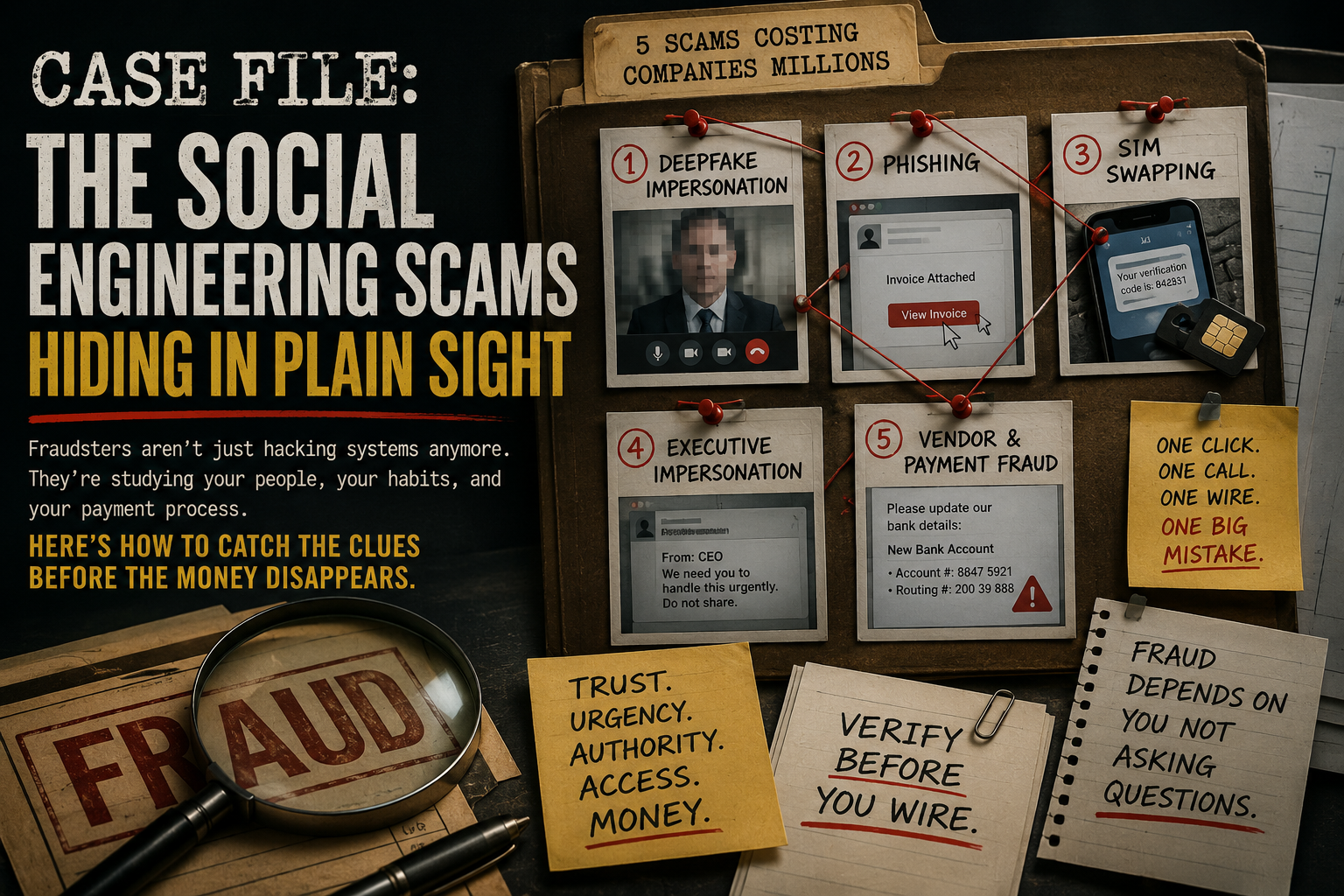
Exhibit A: The Deepfake Impersonation
This is where the case gets uncomfortable.
A team member receives a video call from someone who looks like the owner, CEO, managing partner, or CFO. The voice sounds right. The face looks right. The request sounds important.
“Transfer the funds today.”
“Keep this confidential.”
“We are closing a deal.”
“I need this handled now.”
A few years ago, seeing someone’s face on video may have felt like proof.
Not anymore.
AI has changed the evidence.
A face on a screen is not enough. A familiar voice is not enough. Even a phone call may not be enough if the criminal has done their homework.
So what is the control?
Use a verification method that was established before the suspicious request came in.
A known phone number already on file.
A secure approval system.
A second approver.
A verbal passphrase for high-dollar transactions.
A written policy that says no urgent request gets to skip the process.
The detective rule is simple: if the evidence can be faked, you need corroboration.
Exhibit B: The Phishing Trap
Phishing is the old suspect that keeps changing disguises.
In the past, phishing emails were easier to spot. Bad grammar. Strange formatting. A sender address that looked like it came from another planet.
Now, the disguise is better.
Scammers can write clean emails. They can copy your vendor’s tone. They can reference real projects. They can make a fake login page look almost identical to the real one.
One click, and the door opens.
The employee thinks they are logging into Microsoft, Google, QuickBooks, Dropbox, the bank, or a vendor portal.
But they are really handing the keys to the fraudster.
And once the fraudster is inside the inbox, they do not always strike immediately. They watch.
They learn who approves payments.
They learn when invoices are sent.
They learn which vendors get paid.
They learn who is busy, who is trusting, and who is likely to move fast.
That is not random fraud. That is surveillance.
The fix is not just “be careful.” That is not a control. That is a wish.
Use multi-factor authentication that does not rely only on text messages. Train your team with real examples. Review login activity. Remove old users. Limit access to accounting and payroll systems.
Because in fraud, the first clue is often the login no one noticed.
Exhibit C: The SIM Swap
This one is sneaky.
A fraudster tricks a phone carrier into moving someone’s phone number to a device the fraudster controls. Suddenly, the criminal receives the verification codes that were supposed to protect the account.
That means one-time passcodes, password resets, email access, bank access, payroll access, and accounting system access may all be at risk.
This is why text-message security is not the gold standard anymore.
Your phone number is not just a phone number. It can become a master key.
For business owners, bookkeepers, controllers, and anyone with access to money, this matters.
The control is simple, but too many businesses skip it.
Use authenticator apps or hardware security keys when possible. Lock down carrier accounts with extra protection. Limit who has access to sensitive financial systems. And stop treating convenience like it is the same thing as security.
Because it is not.
Exhibit D: The Executive Impersonator
Every fraudster has a favorite costume.
One of the most effective is authority.
The email appears to come from the owner, CEO, managing partner, or department head. The message is short, urgent, and just believable enough.
“I need you to take care of this today.”
“Do not discuss this with anyone yet.”
“I am tied up in meetings.”
“Send the wire before close of business.”
“Buy these gift cards for a client event.”
“Update this vendor payment information before the next invoice goes out.”
Look closely and you will see the fingerprints.
Urgency.
Secrecy.
Pressure.
Authority.
A request involving money.
That combination should set off every alarm in the building.
A real leader should not expect employees to ignore controls. If the request is legitimate, it can survive verification.
That sentence belongs in every business payment policy.
If the request is legitimate, it can survive verification.
Exhibit E: The Vendor Payment Switch
This is one of the quietest crimes in the file.
No dramatic phone call. No fake video. No wild story.
Just a polite email from a “vendor.”
“Please update our banking information for future payments.”
That is it.
The next payment goes out. The vendor never receives it. The business thinks the invoice was paid. The criminal disappears.
By the time anyone notices, the trail is cold.
This scam works because businesses treat banking changes like routine admin work.
They are not routine.
A change to where money goes is a high-risk financial event.
Read that again.
A change to where money goes is a high-risk financial event.
That means it needs verification, documentation, and approval.
Call the vendor using the phone number already in your records. Confirm the change with a known contact. Do not use the phone number in the email requesting the change. Do not rely on an attached letter. Do not assume a logo makes a document legitimate.
Log who verified the change, when it was verified, and what was confirmed.
That is how you preserve the evidence before there is a crime scene.
The Pattern Every Business Should Notice
These scams may look different on the surface, but the motive and method are usually the same.
The fraudster wants your team to act before they investigate.
They want the request to feel normal enough that no one questions it.
They want it to feel urgent enough that no one slows down.
They want it to come from someone important enough that no one pushes back.
They want your process to be vague enough that one person can make the mistake alone.
That is the pattern.
And once you see the pattern, you can start building the defense.
The Detective’s Checklist for Business Owners
Before money moves, your team should be able to answer these questions:
Who requested it?
Was the request expected?
Does the sender’s email domain match exactly?
Is this a new vendor, new bank account, or new payment method?
Is the request urgent, secretive, or unusual?
Was it verified through a known contact method?
Is there a second approval?
Was the verification documented?
This is not about slowing down every normal transaction.
This is about putting a magnifying glass on the transactions fraudsters love.
Vendor banking changes.
Wire transfers.
Payroll direct deposit changes.
Client refunds.
New vendors.
Large or unusual payments.
Requests from executives that bypass the normal process.
That is where the clues usually are.
How to Close the Case Before It Opens
You do not need a massive fraud department to protect your business.
You need a few strong controls that your team actually follows.
1. Create a Payment Verification Rule
Any new payment instructions or banking changes must be verified using contact information already on file.
No exceptions because someone is busy.
No exceptions because the email looks real.
No exceptions because the request came from “the boss.”
Fraud loves exceptions.
2. Require Two Approvals for High-Risk Transactions
One person should not be able to set up the vendor, change the bank account, and approve the payment.
That is not efficiency. That is exposure.
Separate the duties. Add a second set of eyes. Make fraud harder.
3. Give Employees Permission to Challenge Urgency
Your team needs to know they will not get in trouble for slowing down a suspicious request.
The message from leadership should be clear:
“If money is moving and something feels off, stop and verify.”
That one sentence can save a business.
4. Train With Real Scenarios
Do not hand your team a boring policy and assume the job is done.
Show them real examples.
A fake CEO email.
A vendor banking change scam.
A phishing login page.
A payroll direct deposit request.
A gift card scam.
A deepfake voice message.
People remember cases better than rules.
5. Review Access Like a Detective Reviews Suspects
Who has access to the bank?
Who has access to payroll?
Who has admin access to email?
Who can change vendors?
Who can approve payments?
Who still has access but no longer needs it?
Old users and excessive permissions are loose ends.
And loose ends are where fraud hides.
The Final Clue
Social engineering fraud is not just an IT problem.
It is not just an employee training problem.
It is a business process problem.
The fraudster is counting on your company to move fast, trust too easily, and skip the boring steps.
But boring steps are often what save you.
A callback.
A second approval.
A documented verification.
A pause before payment.
A team member brave enough to ask, “Does this make sense?”
That is how fraud gets stopped.
So here is the question every business owner should ask today:
If a fake vendor, fake executive, or fake emergency showed up tomorrow, would our process catch it?
If the answer is no, the case is already open.
Now is the time to find the weak spot before the fraudster does.
