
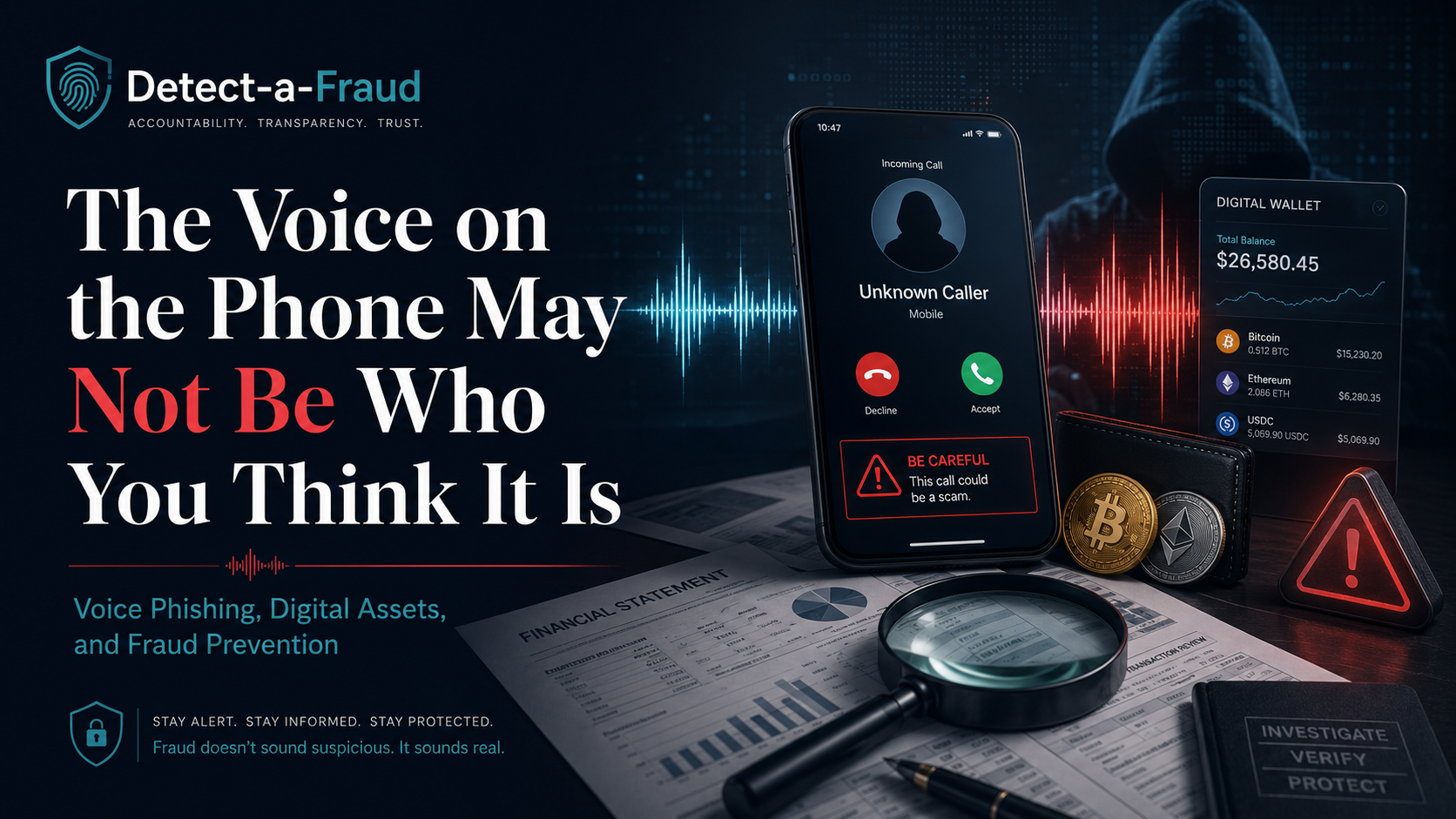
Fraud rarely kicks down the front door.
Most of the time, it walks in politely.
It sounds professional. It knows just enough details to feel credible. It creates urgency. It asks for one small thing, then another, then another.
And before anyone realizes what happened, the money is gone.
A recent report from Maeil Business News Korea highlighted how Dunamu, the operator of Upbit, South Korea’s largest virtual asset exchange, is working with police to fight digital financial crimes, including voice phishing and investment fraud involving virtual assets.
That may sound like a crypto story at first glance.
It is not.
It is a fraud story.
And every business owner, nonprofit leader, law firm administrator, and finance professional should be paying attention.
Because the real lesson is not about cryptocurrency. The real lesson is this:
Fraudsters are getting faster, more convincing, and better at exploiting weak processes.
Exhibit A: The Friendly Voice on the Phone
Voice phishing, also known as vishing, happens when a scammer uses a phone call, voicemail, or voice message to trick someone into giving up information, approving a payment, changing account details, or taking another risky action.
Old-school scams were easier to spot.
The caller sounded suspicious. The story felt thin. The request seemed strange.
Now? Not so much.
Today’s fraudsters can sound like:
A bank representative.
A government agency.
A vendor.
A client.
A managing partner.
A board member.
Even someone you know.
With AI voice tools becoming more available, scammers do not have to rely on a bad script and a fake accent. They can mimic tone, urgency, and authority in a way that makes your team feel like they are talking to the real person.
That is the scary part.
The voice may sound familiar.
The request may sound reasonable.
The timing may feel urgent.
But none of that makes it legitimate.
The Clue Everyone Misses: Urgency
If Detect-a-Fraud had a red string board for voice phishing, urgency would be right in the center.
Fraudsters love urgency because urgency shuts down judgment.
They do not want your bookkeeper to pause.
They do not want your office manager to check the vendor file.
They do not want your treasurer to call the bank using the known number.
They want action now.
Listen for phrases like:
“This has to be handled immediately.”
“Do not involve anyone else.”
“Your account is compromised.”
“The transaction will fail if you wait.”
“I already spoke with the owner.”
“Just send the code I texted you.”
“This investment window closes today.”
That is not normal business pressure.
That is a fraud tactic.
And once you know what you are listening for, the whole case starts to look different.
Why Virtual Assets Make the Case More Complicated
The Dunamu article points to something important: digital assets are increasingly showing up in fraud investigations.
Why?
Because fraudsters love anything that helps them move money quickly.
Virtual assets can create a dangerous mix of speed, confusion, and limited recovery options. A victim may be talked into transferring funds to a wallet, investing through a fake platform, or moving money under the belief that they are protecting their account.
The scammer’s goal is not just to steal.
The goal is to move the money before anyone can stop it.
That is why Dunamu’s partnership with police matters. They are combining fraud detection technology, suspicious transaction monitoring, and law enforcement coordination to respond faster.
In other words, they are doing what good investigators do:
Spot the pattern.
Follow the money.
Freeze what can be frozen.
Act before the trail goes cold.
Your business may not operate a virtual asset exchange, but you still need the same mindset.
You need to know what looks suspicious.
You need a process for escalating concerns.
You need controls that work even when someone sounds convincing.
The Real Crime Scene Is the Process
Here is where most businesses get it wrong.
They think voice phishing is a “people problem.”
Someone should have known better.
Someone should have questioned it.
Someone should have spotted the scam.
But that is not how strong fraud prevention works.
A good fraud control system does not depend on one person being perfect on a busy Tuesday afternoon.
It assumes people are human.
People get rushed.
People want to be helpful.
People respond to authority.
People make decisions too quickly when someone is pressuring them.
That is why the real crime scene is usually not the phone call.
It is the process that allowed one phone call to override financial controls.
A scammer does not need to hack your accounting system if they can talk someone into bypassing it.
They do not need your bank password if they can get an employee to approve a wire.
They do not need access to your payroll system if they can convince someone to change direct deposit instructions.
Fraudsters are not just attacking your technology.
They are attacking your habits.
Red Flags Worth Pinning to the Evidence Board
Every team member who touches money, banking, payroll, vendor records, client funds, donor funds, or sensitive information should know these warning signs.
Watch for:
A caller who demands immediate action.
A caller who says not to tell anyone.
A request to move money to a new account.
A vendor who suddenly changes payment instructions.
A client who wants a refund sent somewhere unusual.
A request for a login code or multi-factor authentication code.
A request involving crypto, gift cards, wire transfers, or other hard-to-recover payment methods.
A caller who claims to be a bank, government agency, police department, software company, or executive.
A tone that makes the employee feel afraid, rushed, or embarrassed to ask questions.
That last one matters.
Fraudsters are emotional manipulators.
They want the victim to feel like stopping to verify would be rude, disloyal, or incompetent.
Do not fall for that.
Verification is not rude.
Verification is smart.
How to Build Your Fraud Defense File
You do not need a massive policy binder collecting dust on a shelf.
You need practical controls your team will actually use.
Here is where to start.
1. Create a “Known Number Only” Rule
If someone calls with a financial request, your team should verify it using contact information already on file.
Not the number the caller gives them.
Not the number in a suspicious email.
Not the number from a text message.
Use the bank portal, vendor record, client file, board directory, or official website.
This one rule can stop a lot of fraud.
Why? Because scammers can control the number they give you. They usually cannot control the number already sitting in your records.
2. Require a Second Reviewer Before Money Moves
One person should not be able to receive the request, approve the request, and release the money.
That is not efficiency.
That is exposure.
Two-person approval is not about mistrusting your team. It is about protecting good people from being put in bad positions.
When money moves, someone else should review the request, the supporting documentation, the payment details, and the verification steps.
Especially when the request is urgent.
Urgency should not reduce controls.
Urgency should increase them.
3. Treat Payment Changes Like Evidence
A payment change should never be casual.
Vendor changed bank accounts? Evidence.
Employee changed direct deposit? Evidence.
Client wants funds returned to a different account? Evidence.
Board member requests a same-day payment? Evidence.
Document who made the request, how it was verified, who approved it, and what account details changed.
Fraud prevention gets much easier when your team knows every unusual financial request leaves a paper trail.
4. Ban Code Sharing
No one on your team should ever share a multi-factor authentication code, password reset code, bank security code, or login verification code over the phone.
Not with the bank.
Not with tech support.
Not with the “fraud department.”
Not with someone claiming to be the owner, managing partner, executive director, or board chair.
Those codes are not confirmation numbers.
They are access keys.
Treat them that way.
5. Practice the Pause
This is the simplest control and maybe the most powerful.
When a call creates panic, pressure, or urgency, pause.
Hang up.
Verify.
Escalate.
Document.
Fraudsters want momentum. Your job is to interrupt it.
A 10-minute pause can save a business from a six-figure loss.
The Detective’s Question
Every good investigation starts with better questions.
So here is the question every business should ask:
“If a convincing fraud call came in today, would our process catch it before the money left?”
Not, “Do we trust our people?”
Of course you do.
Not, “Would we be smart enough to spot it?”
That is not the standard.
The real question is whether your financial controls are stronger than the scammer’s script.
Because fraud prevention is not about paranoia.
It is about building a system that protects your money, your clients, your donors, your team, and your reputation.
Case Closed? Not Quite.
Voice phishing is not going away.
Digital asset fraud is not slowing down.
AI impersonation is only going to get better.
But that does not mean businesses are helpless.
The strongest fraud defenses are often simple:
Verify independently.
Require a second reviewer.
Slow down urgent requests.
Document unusual changes.
Train your team with real examples.
Protect access codes like keys.
That is how you move from reactive to ready.
And when it comes to fraud, ready wins.
Today’s Case Assignment
Pick one process this week: wires, ACH payments, vendor changes, payroll changes, refunds, trust account transfers, or donor disbursements.
Then ask:
Who can request this?
Who verifies it?
Who approves it?
What documentation is required?
What happens if the request is urgent?
If the answers are fuzzy, that is your clue.
Tighten the process now, before a scammer finds the gap for you.
